


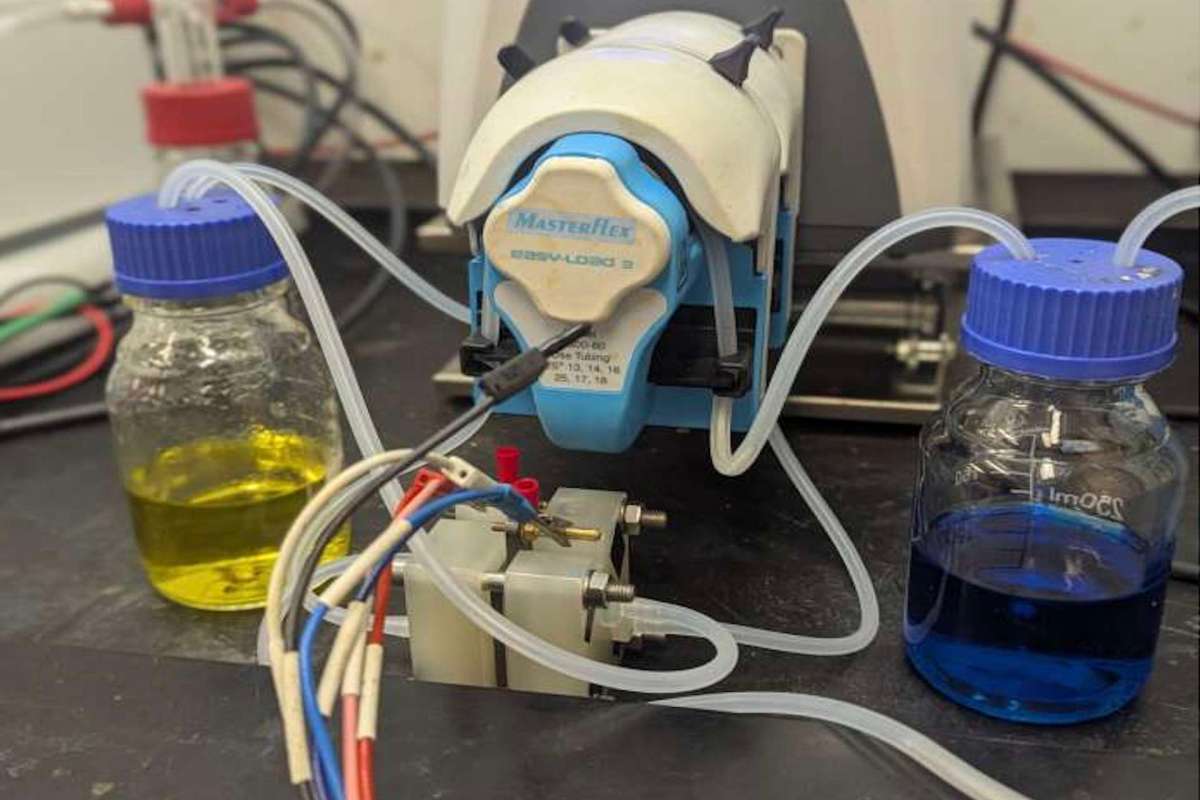
Canadian researchers have developed a 3D-printed battery component that may address a major obstacle to renewable power: safely storing large volumes of electricity for later use.
That may make wind and solar energy a steadier source of power.
Here's what to know
According to Waterloo News, a University of Waterloo group headed by Maxime van der Heijden built a 3D-printed electrode for redox flow batteries. The design borrows from patterns found in nature and reshapes the component to let liquid pass through it more easily.
In redox flow batteries, energy is held in liquid electrolytes. When those liquids circulate more effectively, the reactions involved in charging and discharging can occur more efficiently, improving overall battery performance.
The findings were published in the Journal of Energy Storage in a study titled "Enhancing Mass Transport in Redox Flow Batteries with 3D-Printed Triply Periodic Minimal Surface Electrode Structures."
Breakthroughs such as this could keep renewable electricity available after the sun goes down or the wind lets up.
TCD Picks » Quince Spotlight
💡These best-sellers from Quince deliver affordable, sustainable luxury for all




More background
Energy storage remains one of the most important pieces of the clean energy puzzle. Wind and solar farms can generate enormous amounts of electricity but not always when households, businesses, and cities need that power most.
Redox flow batteries are especially well suited for large-scale storage. Unlike some other battery systems, they can be scaled up by increasing the size of their storage tanks, making them particularly attractive for grid-level use.
They are also often seen as a safer option for stationary energy storage because they rely on liquid-based systems rather than concentrating the energy in a solid-battery cell. That can make them more appealing to utilities and facilities seeking resilience without taking on as much fire risk.
If such systems become more efficient and easier to produce, they could reduce wasted renewable electricity, ease grid strain, and strengthen backup power options during blackouts or extreme weather events.
What's being done?
The project focuses on refining the inside of long-duration batteries to make them more practical and affordable.
"With 3D printing, we can design the internal structure of an electrode in ways that are difficult to achieve using conventional manufacturing," van der Heijden said, per Waterloo News. "That gives us much greater control over how the liquid moves through the battery and reaches the surfaces where the energy-storing reactions take place."
That could help storage systems deliver stronger performance with less wasted energy.
The work is part of a field focused on making clean energy available whenever it is needed, not just when the weather cooperates.
Across the grid, this kind of electrode may support more reliable renewable electricity storage with a stronger safety profile.
Where can I learn more?
Researchers are tackling the storage problem from several directions, all with the goal of making clean electricity easier to hold onto and use when wind and solar output dips. The advances range from new chemistries to stronger materials and manufacturing upgrades that could improve long-duration battery storage.
• Researchers have unveiled near-perfect battery technology to transform renewable energy storage.
• At Penn State, engineers refined next-generation energy storage manufacturing for futuristic solid-state batteries.
• At NTNU, engineers tested improved lithium-sulfur coatings to extend battery performance.
Energy storage is moving fast, and no single battery design is likely to solve every challenge on its own. Building cleaner, more reliable grids will require a mix of safer, more efficient ways to store renewable power for later use.

Get TCD's free newsletters for easy tips, smart advice, and a chance to earn $5,000 toward home upgrades. To see more stories like this one, change your Google preferences here.






