


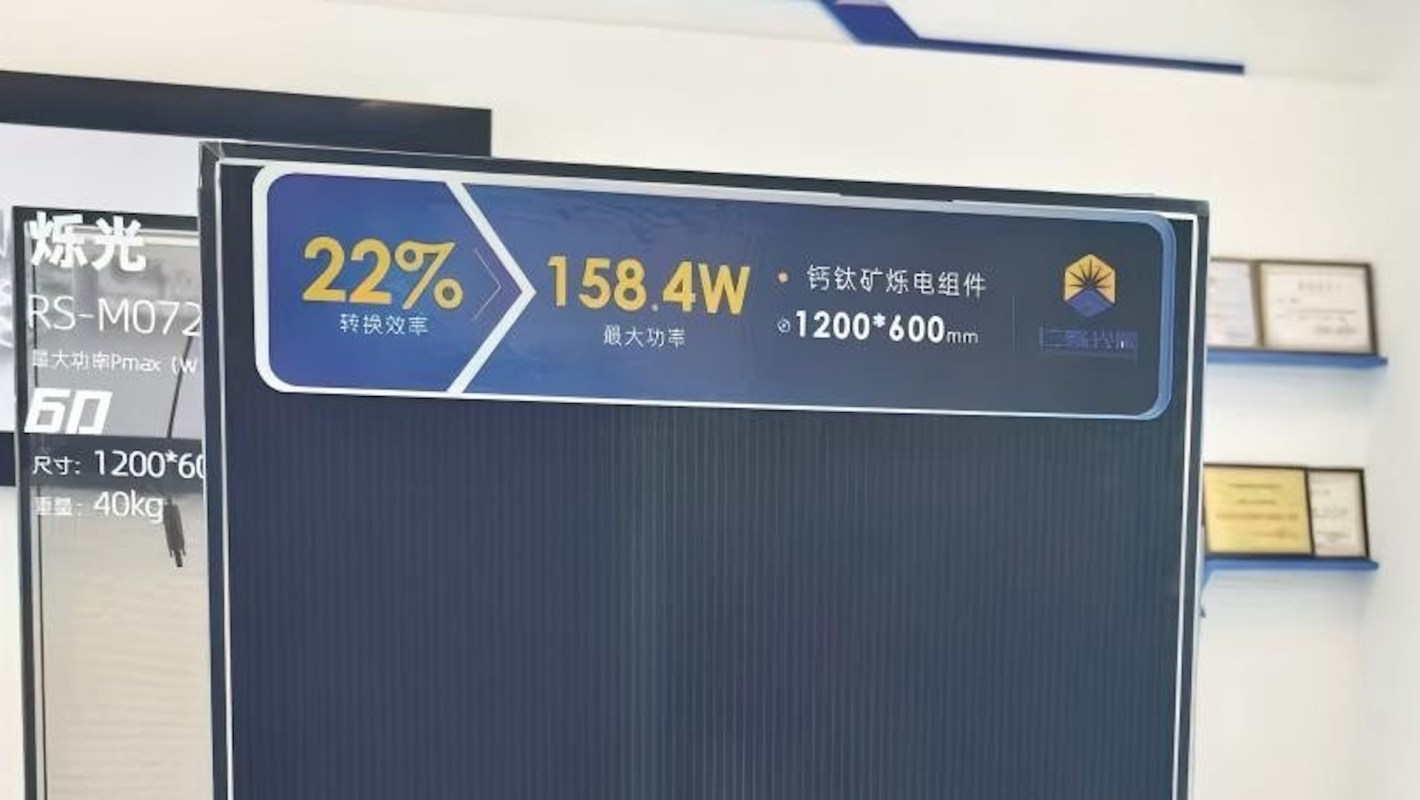
A research team led by Nanjing University in China and perovskite specialist Renshine Solar has set a new benchmark for large-area solar technology: a 125.6-square-inch (810-square-centimeter) aperture module certified at 24.0% efficiency.
The stronger efficiency and durability could help lower the cost of solar electricity for homes, businesses, and cities while cutting the planet-warming pollution associated with conventional power.
Here's what to know
According to PV Magazine, testing showed the module reached a top conversion efficiency of 24.2%, while TÜV SÜD in China separately certified a 24.0% result.
Corresponding author Ke Xiao said, "This result represents a world record for this perovskite module format."
The breakthrough centered on a passivation strategy using chemically stable lead carboxylate passivators, or LCPs, derived from lead dioleate. Researchers said the method improved charge-carrier transport while avoiding some of the chemical and thermal stability problems seen with more conventional ammonium halide passivators.
In testing, the module recorded 53.46 volts open-circuit, 0.436 amps short-circuit, and an 83.40% fill factor.
TCD Picks » Quince Spotlight
💡These best-sellers from Quince deliver affordable, sustainable luxury for all




Xiao added: "It also maintained a stable 19.4 W output under maximum power point tracking (MPPT). This marked the first perovskite solar module exceeding 800 cm² to surpass 24% efficiency."
More background
Perovskite solar cells have attracted significant interest because they may deliver higher performance at lower manufacturing costs than traditional silicon panels.
The challenge, however, has been scaling the technology without sacrificing efficiency or long-term stability.
The researchers said the LCP treatment produced evenly coated, water-repelling films that held up better against moisture, heat stress, and UV exposure than films treated with ammonium halide passivators.
Measurements put carrier lifetime at 706 nanoseconds, up from 264 nanoseconds, a sign of reduced carrier trapping and stronger passivation.
For larger, meter-scale devices, the team produced 150 modules measuring 7.75 square feet (0.72 square meters). Those modules averaged 144 watts, and the best performer delivered 158.4 watts and earned a 22.0% efficiency certification.
What's being done?
Beyond raising efficiency, the researchers said the process also improved module durability.
Xiao said that after 1,300 hours in damp heat, LCP modules were down just 2% from their starting efficiency, compared with 39% for ammonium halide passivator modules.
They also said all LCP-modified modules satisfied IEC 61215 reliability requirements.
The researchers said: "Overall, combining high-saturated-vapor-pressure (SVP) processing with chemically stable LCP passivation provides an industry-ready route to efficient, durable and scalable meter-scale perovskite photovoltaics."
Where can I learn more?
This progress is part of a broader push to make next-generation solar hardware more efficient, easier to scale, and durable enough for real-world use. It also reflects how materials choices, module design, and field conditions are shaping the next phase of commercial photovoltaics.
• A solar company pushed the 30% solar barrier with scalable perovskite-silicon tandems.
• In China, manufacturers unveiled revolutionary anti-dust solar panels to protect output in dusty conditions.
• Scientists developed a fluorine-free polymer that could ease persistent electronics manufacturing problems.
These examples show why the Nanjing University record matters beyond a single efficiency mark. The breakthroughs with the biggest industry impact are the ones that also improve manufacturability, durability, and performance at scale.

Get TCD's free newsletters for easy tips, smart advice, and a chance to earn $5,000 toward home upgrades. To see more stories like this one, change your Google preferences here.






