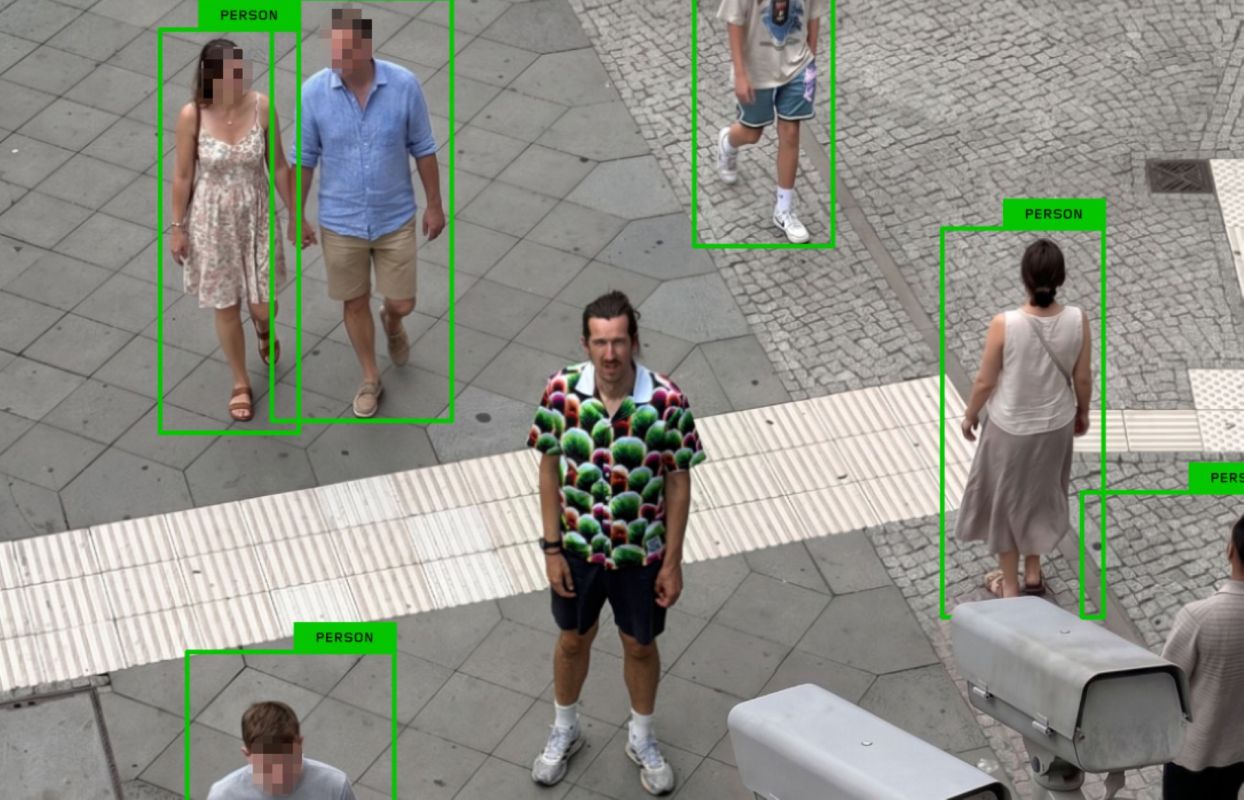
AI-powered surveillance is showing up in more everyday settings, and people are not happy about the dystopian technology. German designer Simon Weckert has an answer to that trend, and it takes the form of ugly clothing.
The German designer made an intentionally garish aloha-style shirt meant to help the wearer slip past AI camera systems.
Here's what to know
According to Dezeen, Weckert developed the shirt's warped, high-contrast pattern to throw off AI-powered surveillance tools.
The pink, orange, and green shapes are arranged to scramble the visual patterns those systems depend on, so the body is less likely to be read as a person.
According to Weckert, the design exploits a core limitation in machine vision.
"AI systems are made of multiple layers and never learned what a human is — they learned what humans statistically look like in millions of training images," he said.
TCD Picks » Quince Spotlight
💡These best-sellers from Quince deliver affordable, sustainable luxury for all




He added: "A 'person,' for the machine, is a bundle of visual statistics — and that is exactly its weakness."
The project offers a response to invasive monitoring by framing privacy as something built into everyday clothing.
More background
Weckert used AI to help create the shirt, specifically an adversarial trial-and-error loop.
That irony fits with Weckert's style of work; the designer, who has described himself as a "modern-day digital wizard," also drew attention in 2020 after using a smartphone-packed wagon to create fake traffic jams in Berlin.
Futurism also linked the project to William Gibson's 2010 novel Zero History, which imagined an "ugliest T-shirt in the world."
Gibson described that fictional garment as "beyond punk, beyond art, and fundamentally, somehow, an affront."
The concept taps into a growing real-world concern. As AI cameras spread across retail stores, streets, and transit systems, many people are looking for practical ways to reduce unwanted tracking.
What can be done?
Projects like Weckert's test the limits of surveillance technology and bring a sense of control and freedom back to the people.
Projects like this one shed light on technology many are concerned about and can also pressure companies and policymakers to be more transparent about how these tools are used and how dependable they really are.
If products like this ever move beyond conceptual design, they could offer a relatively accessible privacy tool.
At the same time, clothing alone will not solve the problem. Clear rules around AI surveillance, data storage, and public consent remain central to protecting privacy.
Whether it becomes a mainstream privacy product or remains an art experiment, Weckert's concept captures attention: "To a human it reads as an almost hypnotic textile; to the AI model it reads as nothing at all."

Get TCD's free newsletters for easy tips, smart advice, and a chance to earn $5,000 toward home upgrades. To see more stories like this one, change your Google preferences here.