


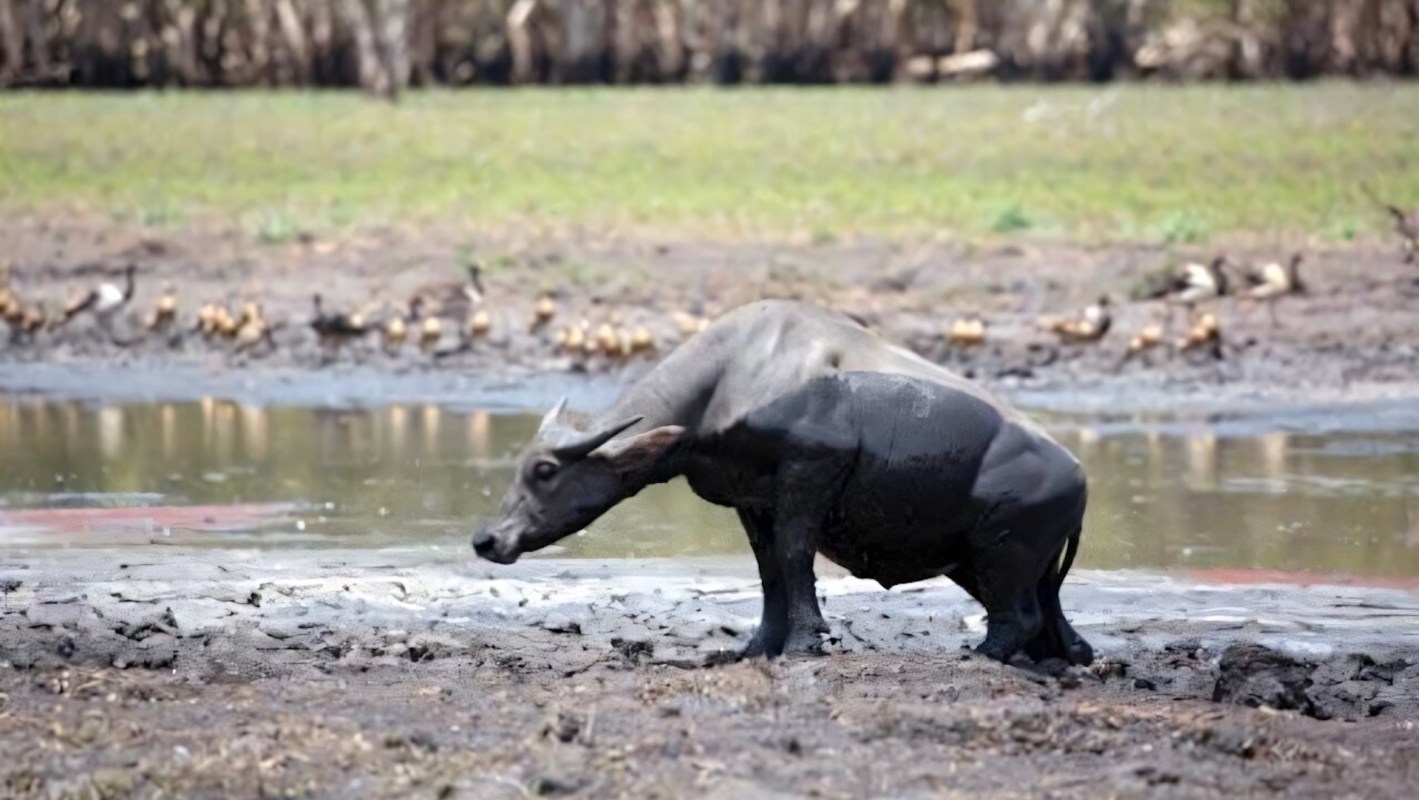
Across Australia's Top End, invasive water buffalo are degrading tropical wetlands, and new research suggests northern long-necked turtles are suffering the consequences.
Here's what to know
According to Phys.org, a Charles Darwin University study examined how feral buffalo are altering wetlands in the Arafura Swamp Indigenous Protected Area in Arnhem Land and what that could mean for northern long-necked turtles. The findings were published in the journal Ecological Management & Restoration.
The long-necked turtles, or Chelodina rugosa, at the center of the research are found in northern Australia in wetland areas used by First Nations peoples. They are valued for food and cultural reasons, which makes these declines especially consequential for connected communities.
To assess the threat, researchers modeled buffalo impacts on turtles across multiple life stages in both flooded and dry conditions. In the wet phase, buffalo-driven habitat changes were associated with reduced food availability and poorer reproductive success, potentially leaving turtles without the reserves needed for estivation, or summer hibernation.
In the dry phase, the model suggested that buffalo-altered soils could affect turtles during estivation as well as embryos developing in buried nests, while wallows and pugging raise the risk that both turtles and eggs will be crushed.
Why is this important?
Across the Northern Territory, feral water buffalo are already regarded as a major invasive pest. The study classifies them as "ecosystem engineers" because they can create, maintain, significantly modify, or destroy habitats on a large scale.
TCD Picks » Quince Spotlight
💡These best-sellers from Quince deliver affordable, sustainable luxury for all




When heavy animals repeatedly churn mud, compact soil, and strip vegetation, nesting conditions change, temperatures shift, food webs are altered, and native species can lose the shallow, stable habitat they rely on for survival. The degradation of these culturally important wetlands and the loss of a native food source can also weaken community resilience.
What's being done?
Lead author Helen Truscott, a Charles Darwin University Research Institute for the Environment and Livelihoods doctoral candidate and the chief executive of the Arafura Swamp Rangers Aboriginal Corporation, said Arnhem Land's large and persistent buffalo population means conservation work must pair immediate mitigation with longer-term reduction efforts.
"This modeling approach is valuable in clarifying pathways leading to detrimental effects and revealing likely points of mitigation," Truscott said. "The approach we have described here is particularly useful for the management of native species where removal of the feral species is not practical or indirect impacts are dominant."
"For example, to address reduced embryo survival, increasing woody debris at sites may reduce the impact of direct crushing and raised soil temperatures," Truscott continued, describing one possible near-term intervention.
She added that the tactic "would be most useful in select areas of the coastal habitat where there is currently no woody cover, and while we work on long-term buffalo reduction programs."
At the same time, some tools that work elsewhere may not be practical here.
"Fencing, while found to be useful in other locations on smaller scales, likewise is not a feasible conservation action," Truscott said. "The amount of fencing needed would be prohibitive for landscapes the scale of the Arafura Swamp."
While large-scale buffalo removal may not be realistic in the near term, the study gives researchers and land managers a clearer picture of where targeted action could help protect an ecologically and culturally important species.

Get TCD's free newsletters for easy tips, smart advice, and a chance to earn $5,000 toward home upgrades. To see more stories like this one, change your Google preferences here.






