


The headline charging figure in an EV advertisement may tell road-trippers less than it seems.
According to a charging systems designer who posts on YouTube, the peak kilowatt figure featured in marketing often does a poor job of describing what owners will actually see at a fast charger.
Here's what to know
In a detailed YouTube breakdown, the creator behind Shayan_EV (@shayan_ev) said, "The number that every manufacturer puts in their advertising, the big charging number, the one you see on the spec sheet and in the reviews, is close to useless for telling you how fast a car actually charges."
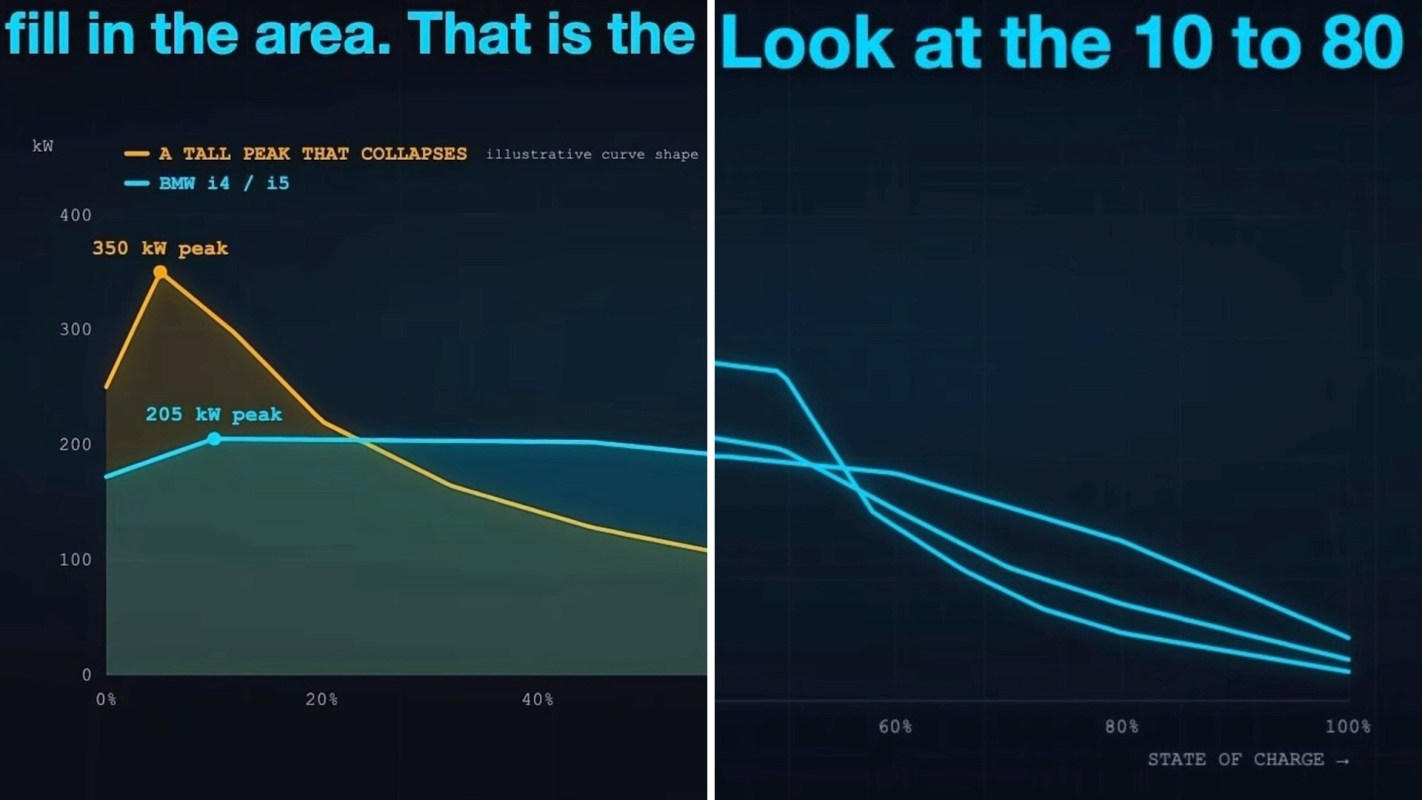
What gets advertised is typically the highest point on the charging session, not the rate a driver gets for very long. Because batteries charge along a curve and gradually accept less power as they fill, the more meaningful real-world experience is the average over the whole stop rather than the brief peak.
That is part of why the Porsche Taycan performs so well in testing. The creator said it peaks at about 320 kilowatts, but independent data shows a 223-kilowatt real-world average, which was described as the strongest sustained average in that comparison. That helps it complete a 10%-to-80% charge in less than 20 minutes.
The BMW i4 and i5 also stood out for the opposite reason many shoppers might expect. The creator said that, although they top out at 205 kilowatts, their flatter charging curves let them beat some models with bigger headline numbers. The Hyundai Ioniq 5 was another example: While many people connect it with 350-kilowatt charging, the creator said that number refers to the charger's rating rather than the vehicle's actual acceptance limit.
TCD Picks » Quince Spotlight
💡These best-sellers from Quince deliver affordable, sustainable luxury for all




More background
A big spec-sheet figure can help sell a car, but it does not automatically mean less time spent charging during a highway trip.
Instead of focusing on the maximum kW number, the creator said shoppers should compare 10%-to-80% charging times, since that reflects the whole charging session rather than a short-lived burst of speed. He also noted that battery size affects the comparison, because larger packs require more energy over that same window, making recovered range another useful part of the picture.
The video also avoided claiming an exact pecking order, grouping vehicles into tiers instead. Near the top were the Taycan and related Audis, Hyundai-Kia 800-volt models, Lucids, and the XPeng G9. Closer to the bottom for road-trip charging, the creator highlighted the BYD Atto 3 and Ford F-150 Lightning.
One commenter wrote, "TL;DR just look at the 10%-80% number, it's a better metric for any real world use." Another added, "The real need is more stations on secondary routes. It's not range anxiety. It's charging station availability anxiety in the countryside."
What can be done?
The creator said a car's badge is often less important than the conditions at the charger. He pointed to three main factors that shape charging speed: the charger's output, the battery's temperature, and the state of charge when the vehicle arrives. On a 50-kilowatt charger, for example, even a faster-charging EV cannot exceed that limit.
Pack temperature can make a major difference. Many EVs now precondition the battery when a driver sets a fast charger as the navigation destination, heating or cooling it to improve charging performance. Showing up with a lower state of charge can help too, because the quickest part of the session usually happens when the battery is still relatively depleted.
One commenter summed up the experience, saying, "By the time I plug in, then find the restroom, then grab a little snack and some water, I am usually only sitting in the car waiting for 10-15 minutes before it is time to go."
As the creator put it, "Flat is better than high. It just doesn't fit as nicely on a poster."

Get TCD's free newsletters for easy tips, smart advice, and a chance to earn $5,000 toward home upgrades. To see more stories like this one, change your Google preferences here.






