


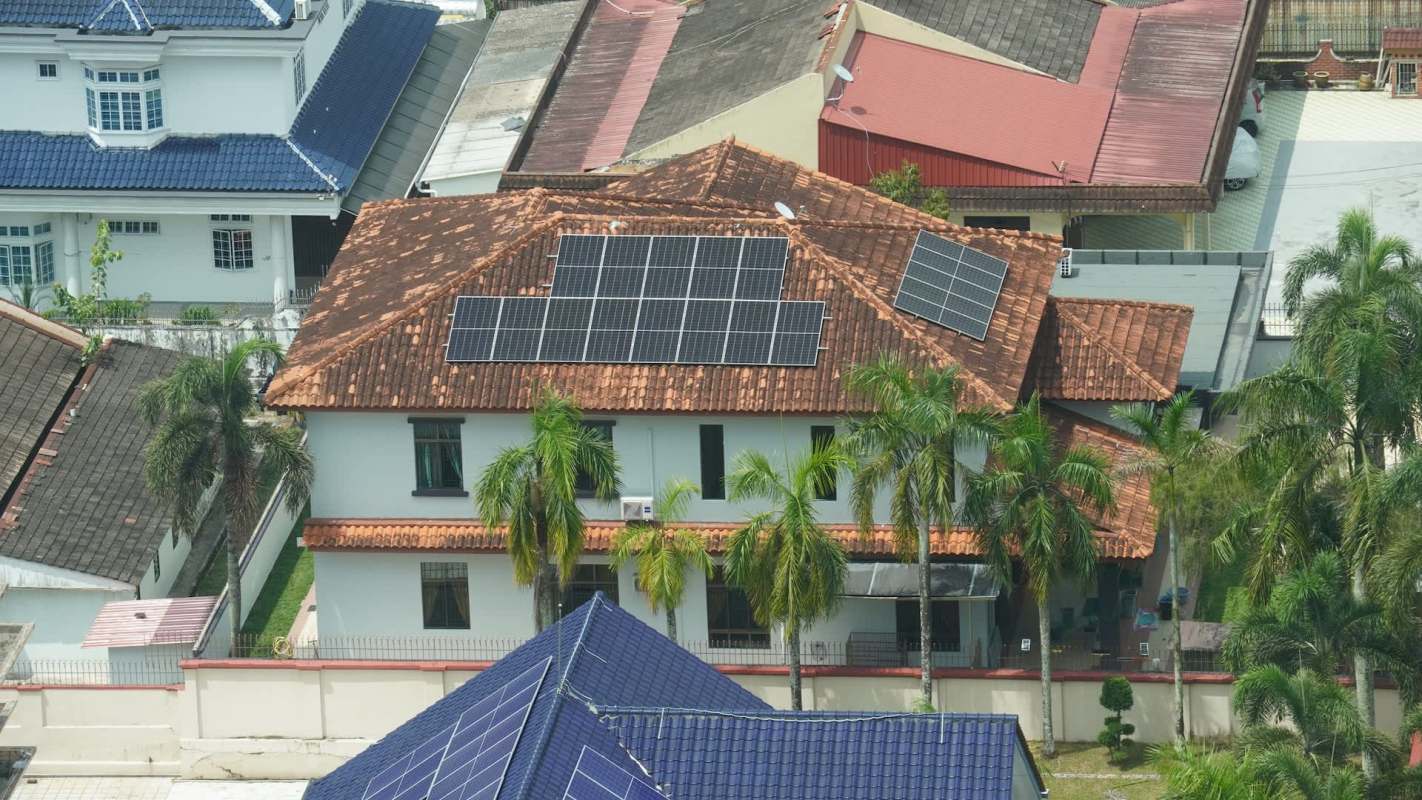
Homeowners and installers in Malaysia now have a clearer rulebook for putting up rooftop solar under the country's two net metering programs.
Here's what to know
As pv magazine reported, Suruhanjaya Tenaga released installation guidance for residential rooftop systems under the NEM Rakyat and NEM GoMEn schemes.
To qualify, applicants generally need to be customers of national utility Tenaga Nasional Berhad, and the solar photovoltaic system must be installed on the roof of the ratepayer.
Under NEM Rakyat, capacity limits depend on the type of household connection. Single-phase homes can install up to 5 kilowatts AC, while three-phase homes can go up to 12.5 kilowatts AC, pv magazine reported.
NEM GoMEn, meanwhile, permits systems as large as 1,000 kilowatts, though the size remains subject to technical and network constraints.
Electricity produced by a rooftop array must be consumed on-site first. When generation exceeds the property's needs, the extra power can be sent to the TNB grid and credited against usage on a one-to-one basis. Those returns may be carried forward for up to 12 months.
TCD Picks » Quince Spotlight
💡These best-sellers from Quince deliver affordable, sustainable luxury for all




That net metering treatment will remain in place for 10 years. After the term ends, the solar system can continue operating but only for self-consumption rather than under NEM bill offsets, as pv magazine noted.
More background
Malaysia has been reworking its solar incentive framework for years.
The country moved from a feed-in tariff to net metering in 2016, then adjusted the policy in 2017 after homeowner uptake came in below expectations.
That was followed by NEM 2.0, which ran from January 2019 until December 2020, and then NEM 3.0, which began in December 2020 with a quota of 2.5 gigawatts.
A rooftop system can reduce how much electricity a household needs to buy from the grid, and the ability to offset usage with exported power can improve the economics of going solar.
What's being done?
Anyone with an installation larger than 72 kilowatts must complete a NEM Assessment Study, and all projects need to meet applicable electrical, safety, technical, and TNB connection requirements.
In practice, households need to verify that they are eligible, ensure the system is tied to the premises, confirm whether the property has a single-phase or three-phase connection, and size the installation within the relevant limits.
Even once the 10-year NEM period has passed, the panels can still lower household electricity use by supplying power on-site.

Get TCD's free newsletters for easy tips, smart advice, and a chance to earn $5,000 toward home upgrades. To see more stories like this one, change your Google preferences here.






