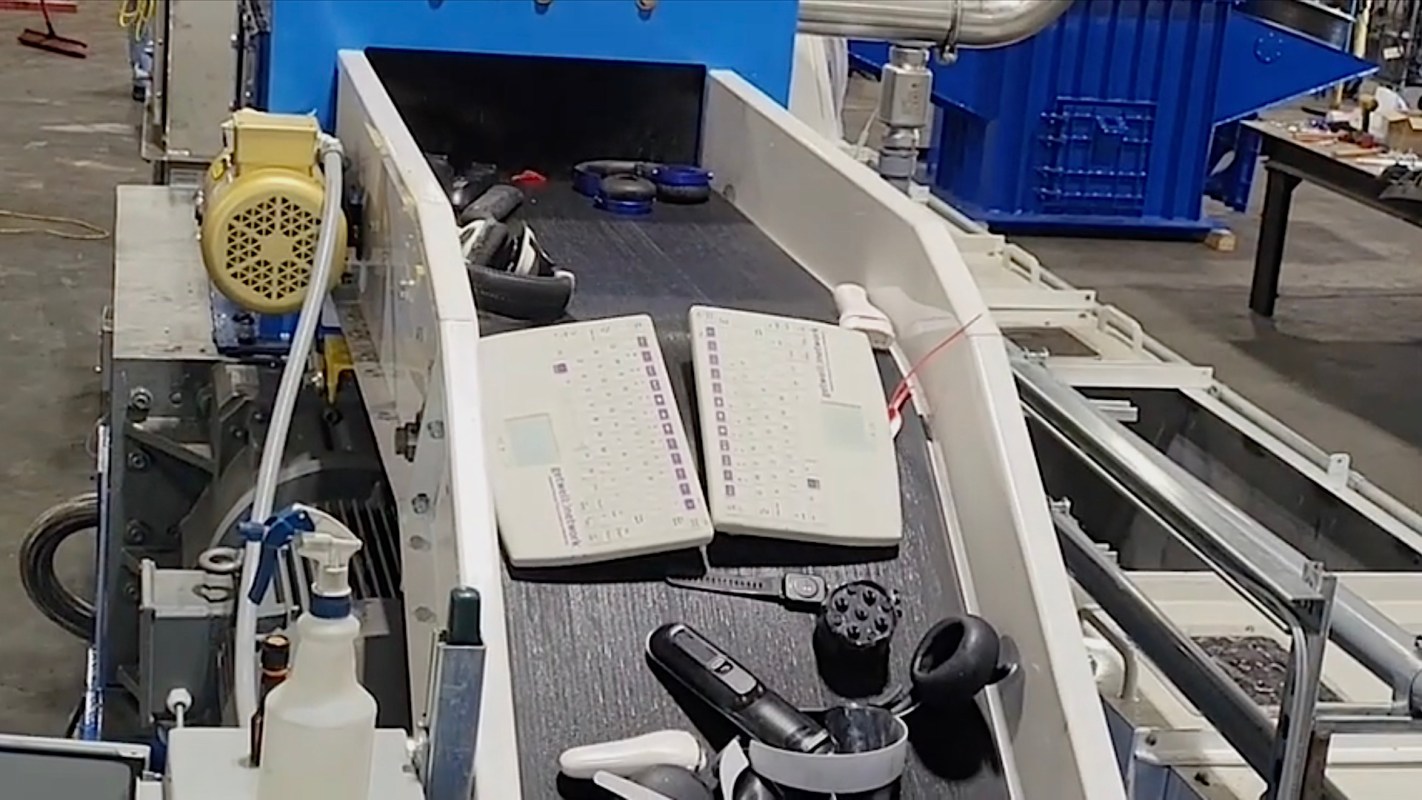
Houston-based Gloyd Recycling Solutions has brought its first U.S. Battery-In-Device Shredding system online, offering recyclers a safer way to handle tiny lithium batteries hidden inside everyday gadgets that can ignite when damaged.
Gloyd Recycling Solutions has put its first U.S. BIDS system into operation, giving recyclers a way to shred products with built-in batteries, including earbuds and vapes, without first taking them apart and with less fire risk.
Here's what to know
According to Resource Recycling, the company's first U.S. BIDS unit is operating for a customer in the Southeast, and two more domestic installations are expected to start up.
For recyclers, the problem has been getting harder to manage as more small devices contain lithium batteries that can ignite if damaged. BIDS is designed to avoid manual battery removal by letting operators feed in loose batteries along with compact electronics such as earbuds, vapes, and similar small devices.
The system ultimately separates material into plastic, ferrous metal, nonferrous metal, and black mass, which can then be reused or sold. Before that happens, the incoming stream passes through a wet shredder designed to reduce fire and explosion hazards, then enters a density separation tank.
Founder Jeff Gloyd emphasized how the industry needed a safer alternative.
TCD Picks » Quince Spotlight
💡These best-sellers from Quince deliver affordable, sustainable luxury for all




"There's a high cost and high risk to battery storage. We figured there had to be a better solution," he said.
More background
The volume of battery-powered consumer products continues to rise, while safe end-of-life systems have struggled to keep up. Small rechargeable batteries are found in everything from wireless earbuds to e-cigarettes, and those devices can become dangerous when stored in bulk or processed with conventional equipment.
A single machine can process about 4 million to 8 million pounds of material per year. Gloyd said it was built for warehouse-level use, and Resource Recycling reported that the plug-and-play unit takes up roughly 750 square feet and requires only power and water.
The equipment has produced encouraging results outside the U.S. Resource Recycling reported that the Australian company EcoBatt began using BIDS in September 2025 at what it described as the first dedicated battery-in-device shredding facility, and said it recovered more than 90% of the minerals from the devices it processed.
What's being done?
After proving the system's capabilities overseas, Gloyd Recycling Solutions is aiming for broader expansion. Resource Recycling reported that the company is targeting major growth in the U.S. and Canada, with Europe next in the second quarter of 2027 and Asia after that.
Smaller operators have had limited options because many major battery processors are seeking loads in the 30,000- to 40,000-pound range.
"The problem was never that recyclers did not want to manage batteries safely," he said. "The problem was that nothing existed at their scale."
Battery-heavy products have become quite common, and choosing longer-lasting products and plastic-free options for everyday items reduces hard-to-process waste.
More facilities adopting systems like this one could mean fewer dangerous fires, safer working conditions, and more of the metals and minerals in devices being reused instead of being discarded.
"We're in an industry where they want to see it and touch it before they use it," Gloyd said. "Now that we've shown that it does what we say it does, we're seeing a lot of interest on the purchase side."

Get TCD's free newsletters for easy tips, smart advice, and a chance to earn $5,000 toward home upgrades. To see more stories like this one, change your Google preferences here.