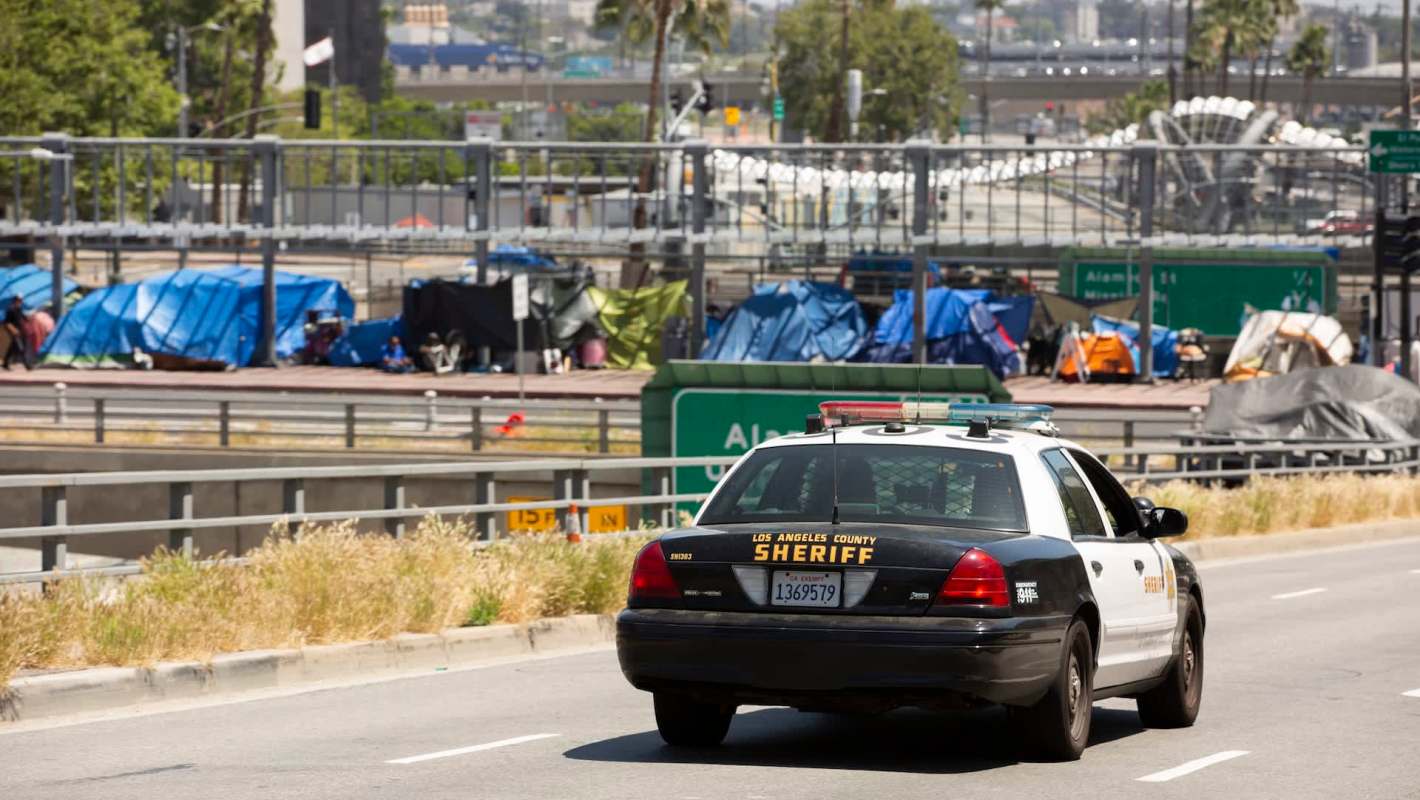
A City Council decision to remove 12 no-camping restrictions in sections of Hollywood, Echo Park, and Silver Lake has reignited Los Angeles' debate over encampment policy.
Here's what to know
On a 10-3 vote, the Los Angeles City Council eliminated discretionary no-camping zones in Council District 13. Councilmembers Imelda Padilla, Traci Park, and Monica Rodriguez opposed the move, while Councilmember Hugo Soto-Martínez pressed for repeal, saying the policy has not meaningfully reduced homelessness.
Supporters and critics have clashed over whether the bans make public spaces safer or simply relocate unhoused residents. Because the city almost never reverses these rules after adopting them, backers of the repeal say the churn of repeated sweeps creates more instability and makes it harder for people to stay connected to housing and services.
As the Los Angeles Times reported, Soto-Martínez argued that strategies centered on enforcement can leave people worse off instead of addressing the root problem.
"Displacing our neighbors from block to block, or in many cases from district to district, doesn't help them find housing," he said. "In most cases, it makes it much harder for us to help them because they lose their belongings, they get fined, and many times they are arrested. To me, that is a policy that does not work."
The affected sites fell under Los Angeles' anti-encampment rules in Municipal Code Section 41.18. The ordinance automatically bans encampments near schools and day-care centers, and it also gives the council authority to add no-camping areas around libraries, senior centers, freeway overpasses, and other "sensitive use" locations.
TCD Picks » Quince Spotlight
💡These best-sellers from Quince deliver affordable, sustainable luxury for all




According to Soto-Martínez, the vote may be the first time the council has undone an encampment ban after putting one in place.
More background
The decision highlights a wider divide at City Hall over the city's homelessness response. Since defeating former District 13 Councilmember Mitch O'Farrell in 2022, Soto-Martínez has resisted new discretionary no-camping zones and has said he would advocate and vote to repeal the law across Los Angeles.
Opponents of the repeal say removing the zones will not necessarily improve conditions. Park argued that, after outreach teams offer shelter and services, the restrictions help keep public spaces open and usable.
"We do outreach," Park said. "We offer beds and services, and we get people off the streets. But after we do that work, we expect that after all that time and money and resources went into an operation, that the area remains safe and clean and accessible."
A Hollywood resident also raised concerns about how the change could affect nearby neighborhoods. Shane Swerdlow, who lives close to the Las Palmas Senior Center, said the policy shift could make surrounding public spaces more difficult for older adults to use safely.
What's being done?
Los Angeles is continuing to pursue different approaches from one district to another. Some council members still rely on 41.18 zones as an enforcement tool, while others are pushing for responses focused more heavily on housing placements, outreach, and service connections.
Kris Rehl, an organizer with LA Street Care and the Abolish 41.18 Campaign, argued that no-camping zones mostly move people around without changing their housing status.
Even some officials who support the law backed Soto-Martínez's request on the basis of local control. Councilmember Bob Blumenfield voted in favor while acknowledging that he would likely make different decisions in another district, saying he trusted Soto-Martínez's judgment in his own area.
Multiple voices in the debate pointed to more lasting solutions, including affordable homes, mental health care, addiction recovery services, and shelter options that do more than temporarily move people out of sight.
As Rehl put it, "The only way to change the housing status of an unhoused person is to house them. Putting them in jail for a short amount of time, fining them with tickets up to $2,500 is not going to change the fact that people are unhoused."

Get TCD's free newsletters for easy tips, smart advice, and a chance to earn $5,000 toward home upgrades. To see more stories like this one, change your Google preferences here.