


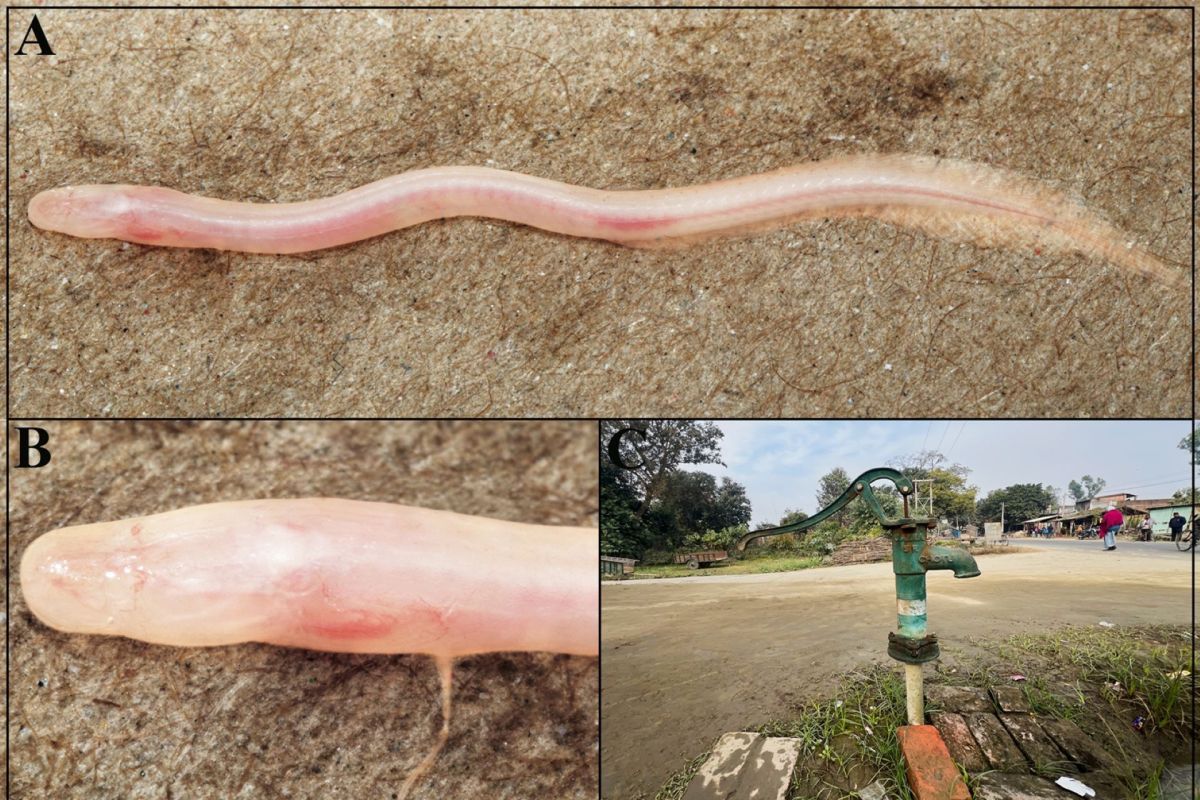
A short TikTok clip of a tiny fish wriggling out of a borewell did more than spark curiosity — it helped scientists identify an entirely new kind of eel living underground in northern India.
The discovery adds an unexpected new piece to the biodiversity of the Gangetic Basin, a region that supports hundreds of millions of people and contains some of South Asia's most important freshwater systems, according to Digital Trends.
Here's what to know
The animal has been described as Gangaichthys indonepalicus, a subterranean earthworm eel found beneath Bihar's Indo-Gangetic Plain near the India-Nepal border, establishing both a new species and a new genus.
The research, published in ZooKeys, involved an international team from the Thackeray Wildlife Foundation, Shivaji University, the Shanghai Synchrotron Radiation Facility, and the Zoological Survey of India.
Scientists said their work was set in motion in 2024 after a TikTok clip showed an unusual fish emerging from a drilled well.
"The unique morphology of the fish in the video, and the fact that there are no known stygobitic fish from the region, motivated us to track down the species to ascertain its identity," the team observed.
TCD Picks » Quince Spotlight
💡These best-sellers from Quince deliver affordable, sustainable luxury for all




Finding the animal was no easy task.
Researcher Akshay Khandekar and colleagues manually pumped hundreds of gallons (thousands of liters) of water from borewells to recover specimens.
The first fish they found was too badly damaged to survive, and the holotype specimen was collected only after another roughly 132 gallons (500 liters) were pumped out.
More background
What makes the discovery especially striking is how different the eel appears to be.
Measuring just about 1.6 inches (four centimeters) long, it seems adapted to permanent darkness, with skin-covered eyes, an unpigmented translucent body, and no ribs.
CT scans and genetic testing showed the eel belonged to the Chaudhuriidae family and represented both a new species and a new genus, broadening researchers' understanding of life hidden in underground aquatic habitats.
Those habitats are important for people as well.
The Gangetic Basin is closely tied to agriculture, drinking water, and everyday life across the region.
The discovery of a previously unknown fish beneath the surface serves as a reminder that groundwater systems can harbor delicate ecosystems that are easy to overlook when borewells and aquifers are viewed solely as resources for extraction.
What's being done?
Researchers have laid the groundwork for future work on where it lives, how widespread it may be, and what threats it could face.
The name itself ties the species to the region.
Agarwal explained that "Gangaichthys means fish of the Ganga," linking the eel to the river system that shapes life across the area. Researcher Tejas Thackeray added that "indonepalicus" refers to its location near the India-Nepal border.

Get TCD's free newsletters for easy tips, smart advice, and a chance to earn $5,000 toward home upgrades. To see more stories like this one, change your Google preferences here.






