


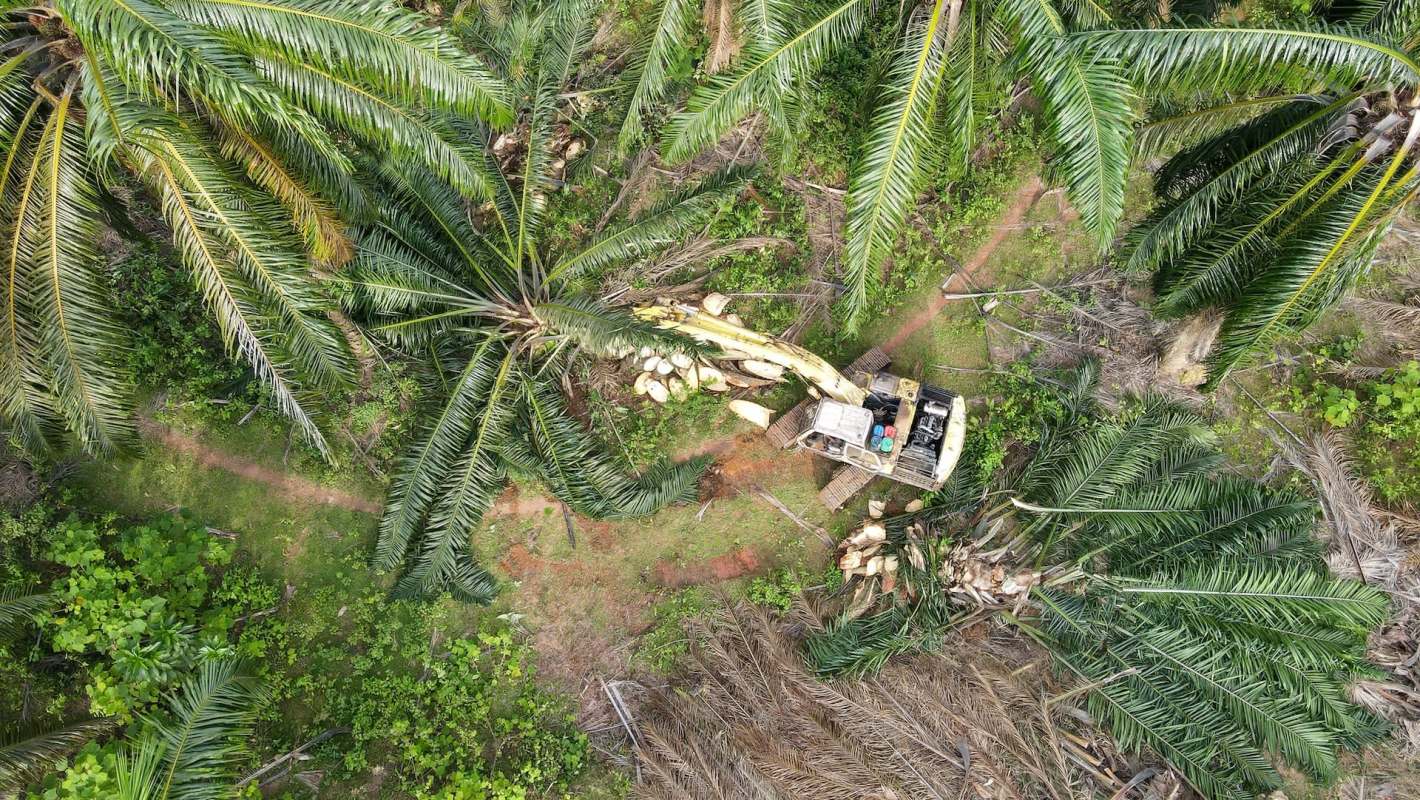
Banks marketed billions of dollars in loans to palm oil giants as "sustainable" — even as some of those same companies were linked to tropical forest destruction.
Here's what to know
According to ESG News, Global Witness found that major financial institutions directed about $31 billion in sustainability-linked lending to high-risk palm oil conglomerates in Southeast Asia from 2018 to 2025.
Although packaged under environmental, social, and governance frameworks, the financing went to borrowers associated with ongoing primary-forest clearing, land disputes, and corruption.
This type of borrowing differs from green bonds in that the funds do not have to be allocated to a specific environmental project.
Instead, companies can use it for general corporate purposes as long as they meet negotiated key performance indicators, which may focus on narrower steps such as cutting operational emissions or electrifying equipment.
To examine how that system worked, Global Witness matched satellite data from Palmoil.io with international lending records. The group said its review showed that loan agreements often lacked legally binding environmental standards and full supply-chain traceability requirements.
TCD Picks » Quince Spotlight
💡These best-sellers from Quince deliver affordable, sustainable luxury for all




The investigation highlighted Wilmar International as one of its most notable examples.
Wilmar adopted a zero-deforestation commitment in 2015, but satellite tracking linked its concessions to about 10,400 acres (4,200 hectares) of primary forest loss from 2016 through 2024.
Nevertheless, lenders extended $950 million in sustainability-linked commitments to the company, while ESG-labeled funds held $46 million in its equity.
More background
Palm oil is a global commodity with impacts that stretch far beyond plantation boundaries.
When primary forests are cleared, the consequences can include increased climate pollution, biodiversity loss, and increased pressure on communities caught in land conflicts.
The pattern was not limited to one company. Musim Mas and Wilmar together obtained $566 million in sustainability-linked borrowing from 2022 to 2025, while local investigations examined corruption in palm oil exports.
Olam Group secured $9.4 billion in total credit facilities from 2018 to 2023 despite having trade ties with suppliers found to be clearing primary forests.
In 2025, Louis Dreyfus arranged $2.3 billion in sustainability-linked credit from a syndicate that included Bank of China, Crédit Agricole, and Rabobank.
Companies and lenders pushed back against the findings.
"We firmly refute any suggestion that deforestation has been carried out by the company as alleged," Wilmar rebutted.
A Barclays spokesperson also defended the bank's process.
"All of our palm oil clients are required to commit to no deforestation, no peatland development, and no exploitation in their operations and supply chain. Clients are assessed against these and other criteria as part of an annual due diligence process," they said.
What's being done?
Global Witness argues that the answer is stronger oversight, not more voluntary promises.
Flossie Boyd, Senior Campaigner at Global Witness, said the findings show that the UK and the EU should implement binding financial rules to stop money from flowing to firms that fail to address deforestation in their supply chains.
Learning how to recognize and question eco-friendly branding claims before trusting them is one practical step. Understanding greenwashing can help consumers and investors spot when sustainability language is being used to polish harmful business practices.
"Voluntary standards on sustainability allow companies to effectively mark their own homework, raising serious questions for responsible investors," Boyd warned.

Get TCD's free newsletters for easy tips, smart advice, and a chance to earn $5,000 toward home upgrades. To see more stories like this one, change your Google preferences here.






