


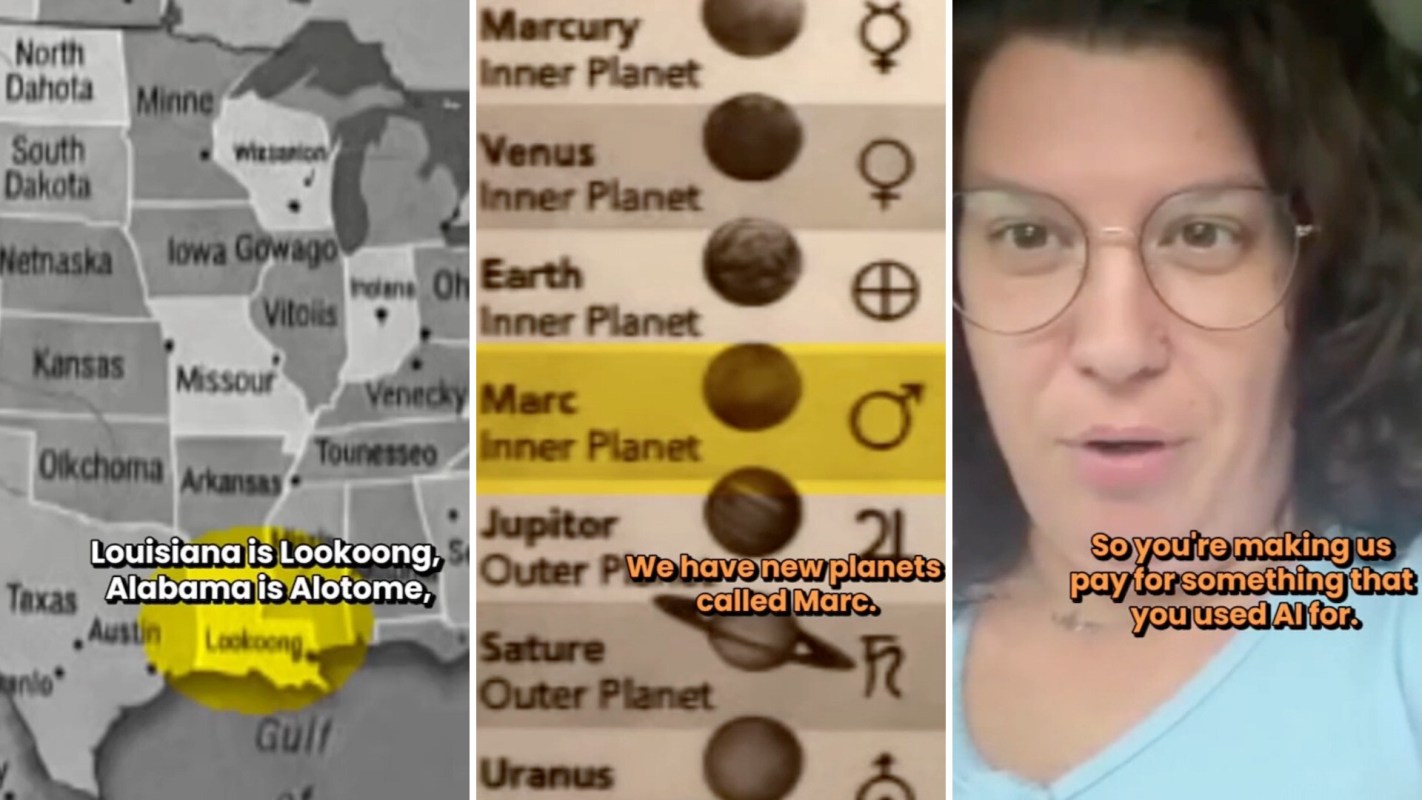
A Kentucky parent says a middle school agenda filled with bizarre spellings and garbled graphics left her family stunned. It also raised an uncomfortable question about whether artificial intelligence was used to create the educational resource.
As Tennessee news station WSMV reported, Stacey Morris said one of the most striking mistakes was a U.S. map that appeared to identify her home state of Kentucky as "Venecky."
Here's what to know
In a short video from WSMV, Morris speaks to the school agenda, which appears to show several strange state names on a U.S. map, including "Lookoong" instead of Louisiana, "Alotome" instead of Alabama, and "Vitoiis" instead of Illinois.
@wsmv4 Stacey Morris, a parent of a Farnsley Middle School student was shocked after her child came home with an agenda containing bizarre misspellings and mistakes through out. One page shows a U.S. map, but has states like Kentucky labeled "Venecky" and Louisiana as "Lookoong." Parents are questioning whether the agenda was AI generated. "We have to pay a ten-dollar instructional fee every year to get this agenda," Morris said. "But you're making us pay for something you used AI for? That's kind of silly, in my opinion." #school #aigenerated #kentucky ♬ original sound - WSMV
Morris shared that the periodic table also appeared to have gibberish written beneath the elements, and a diagram of moon phases included a label that read "waning crescain" instead of "waning crescent," as WSMV's video showed.
"I mean, it's crazy," Morris said in the news clip. Part of her frustration, she said, is that families are charged for the booklet. "We have to pay a ten-dollar instructional fee every year to get this agenda," Morris told the local station.
Viewers in the comments were similarly stunned.
TCD Picks » Quince Spotlight
💡These best-sellers from Quince deliver affordable, sustainable luxury for all




"Even if AI was used, did literally no one proofread???" one asked.
More background
The concerns also extend to issues beyond the classroom, including AI's growing relationship with the energy grid. Running AI systems requires large amounts of computing power, which can drive up electricity use and water consumption at data centers.
That can put added strain on local infrastructure and contribute to higher costs, even as AI may be used in promising ways to forecast renewable energy output, improve battery storage, and help utilities operate cleaner, more efficient grids.
When it is used carelessly, the downsides can include misinformation, wasted resources, security risks, and a sense that important decisions are being handed over to tools that strain resources and have social and environmental impacts.
What can be done?
Documenting errors and asking schools or districts for clear answers about who created certain educational materials, what review process was used, and whether corrected copies or refunds will be offered is one practical next step.
When families are paying for kids' instructional resources, accuracy matters. Even if AI-assisted tools are used for drafting or design, they still need rigorous human oversight. Proofreading by editors, teachers, or subject-area staff can catch obvious mistakes before they reach students.
Districts exploring AI can set rules around transparency, privacy, and quality control. AI may eventually help educators save time or personalize lessons, but only if it is used carefully and never as a substitute for checking work that children depend on.
For Morris, the issue seems fairly straightforward.
"You're making us pay for something you used AI for?" she posed to WSMV. "That's kind of silly, in my opinion."

Get TCD's free newsletters for easy tips, smart advice, and a chance to earn $5,000 toward home upgrades. To see more stories like this one, change your Google preferences here.






