


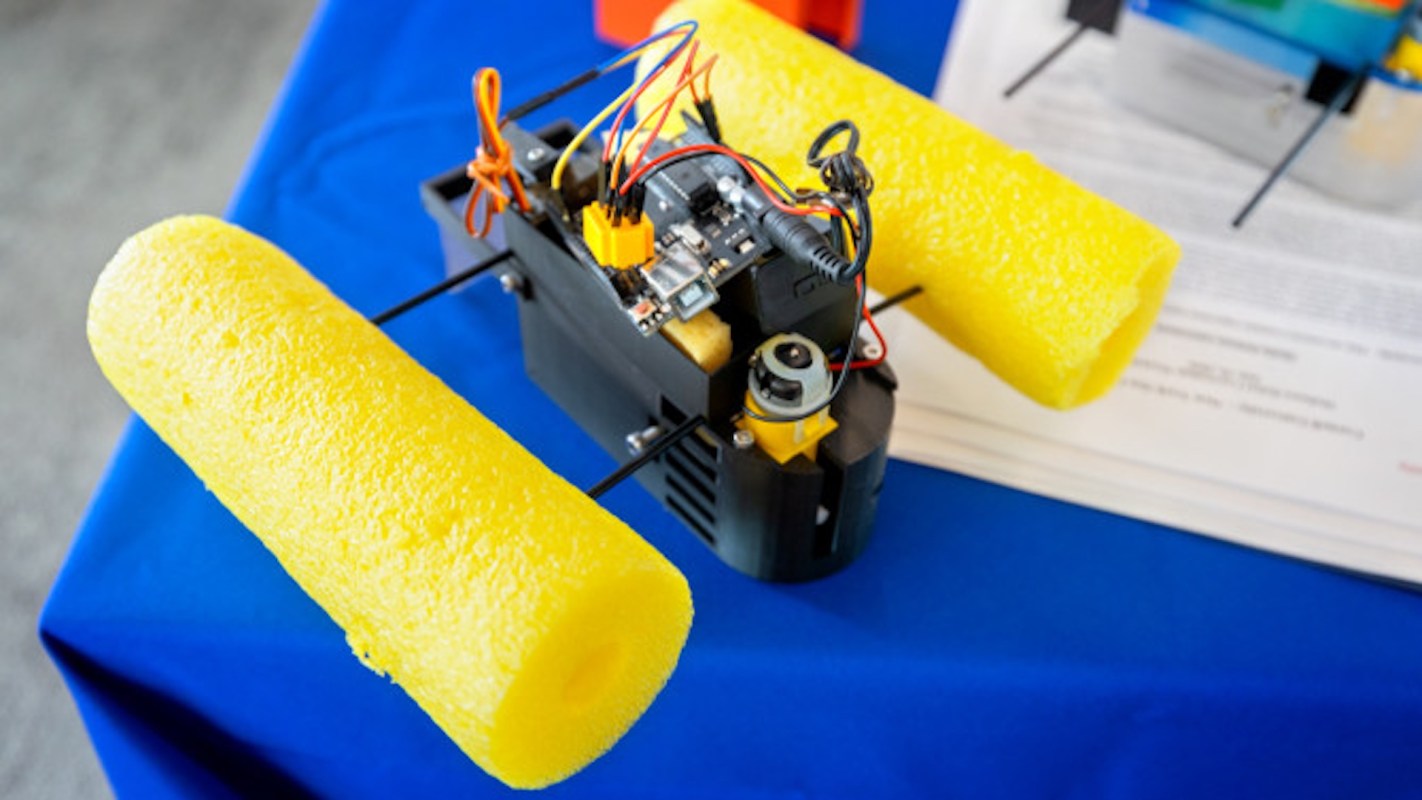
A group of New York teachers is battling one of the world's messiest pollution problems while taking inspiration from an unlikely source: the aquatic snail.
At a workshop at Cornell University, educators built and tested small robots that skim surface water and capture microplastics. The classroom-friendly devices are adapted from a research project on how snails move and feed.
What happened?
According to the Cornell Chronicle, during the workshop sessions, Sunny Jung, a professor of biological and environmental engineering in the university's College of Agriculture and Life Sciences, asked teachers to consider the aquatic snail's rippling motion. The pattern can draw in particles floating in the water from as far as 10 times the animal's body length away.
The snail's movement was the basis for a robot Jung worked on called Mollusca, which takes in water at the surface and filters out microplastics, the outlet reported.
At the workshop, researchers and staff from Cornell, New York Sea Grant, Princeton University, and the University of Michigan ran training sessions, provided lesson plans, and distributed hands-on kits so teachers can bring the robot into classrooms.
As the Chronicle reported, the effort started with its first two-day workshop in July 2025 for 25 teachers and expanded this year to 43 more educators through sessions at Cornell and in New York City.
TCD Picks » Quince Spotlight
💡These best-sellers from Quince deliver affordable, sustainable luxury for all




Teachers built the robots themselves and then tested them in a kiddie pool filled with nurdles, the Chronicle said.
For Emily Colletta, who leads the gifted and talented program at North Tonawanda Intermediate School, the appeal was how usable the training felt.
"The Sea Grant trainings are the best I've ever done," Colletta said. "They're super interactive, and it's always local, which makes it easier to integrate and for the kids to benefit."
Why does it matter?
Microplastics have become nearly unavoidable, showing up in waterways, in the human body, and in many other places.
TCD Picks » Quince Spotlight
💡These best-sellers from Quince deliver affordable, sustainable luxury for all
The Cornell Chronicle reported that microplastics in the environment are expected to double by 2040, and the particles have already been found in at least 1,300 species and in the human body.
Programs like this give teachers a way to connect science, engineering, and environmental health with problems affecting local communities around the world.
Colletta told the Chronicle that her students do not have to look far to understand the issue.
"My students can go to this park by us and find nurdles anytime from a nearby plastics factory, so it's very relevant for them," she said.
These robots are unlikely to solve ocean plastic pollution on their own, but they may still help scientists better understand where microplastics accumulate and the best ways to collect them.
What's being done?
According to the Chronicle, funding from the National Oceanic and Atmospheric Administration's Marine Debris Program backed the Mollusca concept in 2024, and researchers built several 12-by-12-inch prototypes. The robots have logged 80 hours of swimming in a lab kiddie pool, while teams at Princeton and the University of Michigan study wave performance and larger versions for the Great Lakes.
Meanwhile, New York Sea Grant is turning the research into lessons suited to different grade levels.
The Cornell Chronicle reported that Colletta created a three-month Great Lakes unit around the project, and Taryn Matteson, a teacher at Tapestry Charter High School in Buffalo, said she received "total buy-in" from Advanced Placement Biology students.

Get TCD's free newsletters for easy tips, smart advice, and a chance to earn $5,000 toward home upgrades. To see more stories like this one, change your Google preferences here.







