


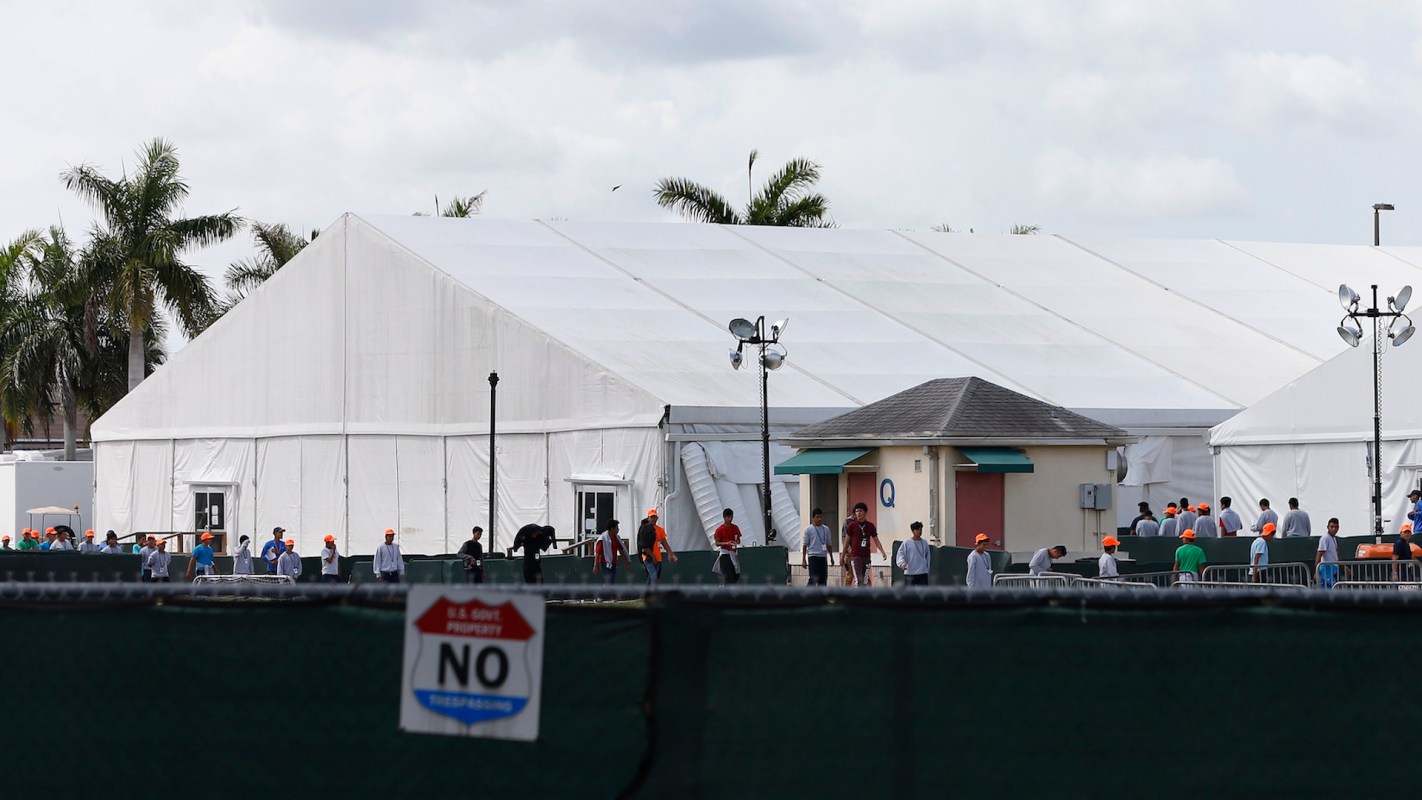
Newly released federal records indicate that children at a now-closed migrant detention center outside Miami were exposed to arsenic, lead, and other hazards.
Those documents deepen long-standing concerns about the Homestead facility, showing that children were housed beside an Air Force Reserve base with a history of contamination and the constant noise of fighter jets.
What happened?
Some of the more than 20,000 pages released through federal litigation involve children as young as six and concern the Homestead migrant detention center, which closed in 2019 and sat next to Homestead Air Reserve Base, a federally designated Superfund site. The records describe children being housed near toxic chemicals linked to developmental harm and cancer, according to Inside Climate News. The base has a documented history of contamination.
In 2021, Earthjustice sued the Air Force, Homeland Security, the Department of Homeland Security, and Immigration and Customs Enforcement on behalf of the American Friends Service Committee to force the records' release. The case ended last week when the federal government agreed to cover the legal fees of the groups that filed it.
The Air Force would not discuss the case. The department pointed questions to the Department of Health and Human Services, which offered no comment either, according to Inside Climate News.
Homestead first opened in 2016 under the Obama administration as an "emergency influx shelter," then closed briefly in 2017 and reopened the following year. The population eventually swelled to more than 3,700 children, making it the country's largest juvenile detention center at the time, the groups said.
TCD Picks » Quince Spotlight
💡These best-sellers from Quince deliver affordable, sustainable luxury for all




Some of the children held there had been separated from their parents at the U.S.-Mexico border rather than arriving alone, the records showed.
Why does it matter?
Because children's bodies and brains are still developing, exposure to arsenic and lead can be especially harmful. The released records pointed to contaminants linked to cancer and organ damage, including to the kidneys, liver, and immune system, according to Inside Climate News.
Chemical exposure was not the only hazard. Children also heard F-16C jets arriving and departing at the neighboring base at noise levels the records connected to cognitive problems and developmental delays.
Despite the site's known contamination history and its proximity to 16 pollution sources, the records showed no evaluation of environmental hazards or cleanup of the affected areas took place. In a coastal region already prone to intensifying storms, the facility's closure came partly because it had no hurricane plan, a gap that further fueled concerns about whether the facility was ever appropriate for children in the first place.
What's being done?
With the documents now public, advocates and attorneys have more evidence to examine how detention sites are selected and operated.
That paper trail could shape future legal challenges and make it harder for agencies to overlook environmental risks.
Guadalupe de la Cruz, the American Friends Service Committee's Florida program director, said, "It really does mark a victory of how much pressure organizations can be putting on the government for accountability." She also said the Homestead case shows "the repeated pattern" of the government using "contaminated land to set up detention facilities."
Roughly 60 miles southwest of Homestead, a lawsuit accused the "Alligator Alcatraz" detention center of illegally polluting the air around its Everglades site before it closed this past June.

Get TCD's free newsletters for easy tips, smart advice, and a chance to earn $5,000 toward home upgrades. To see more stories like this one, change your Google preferences here.






