


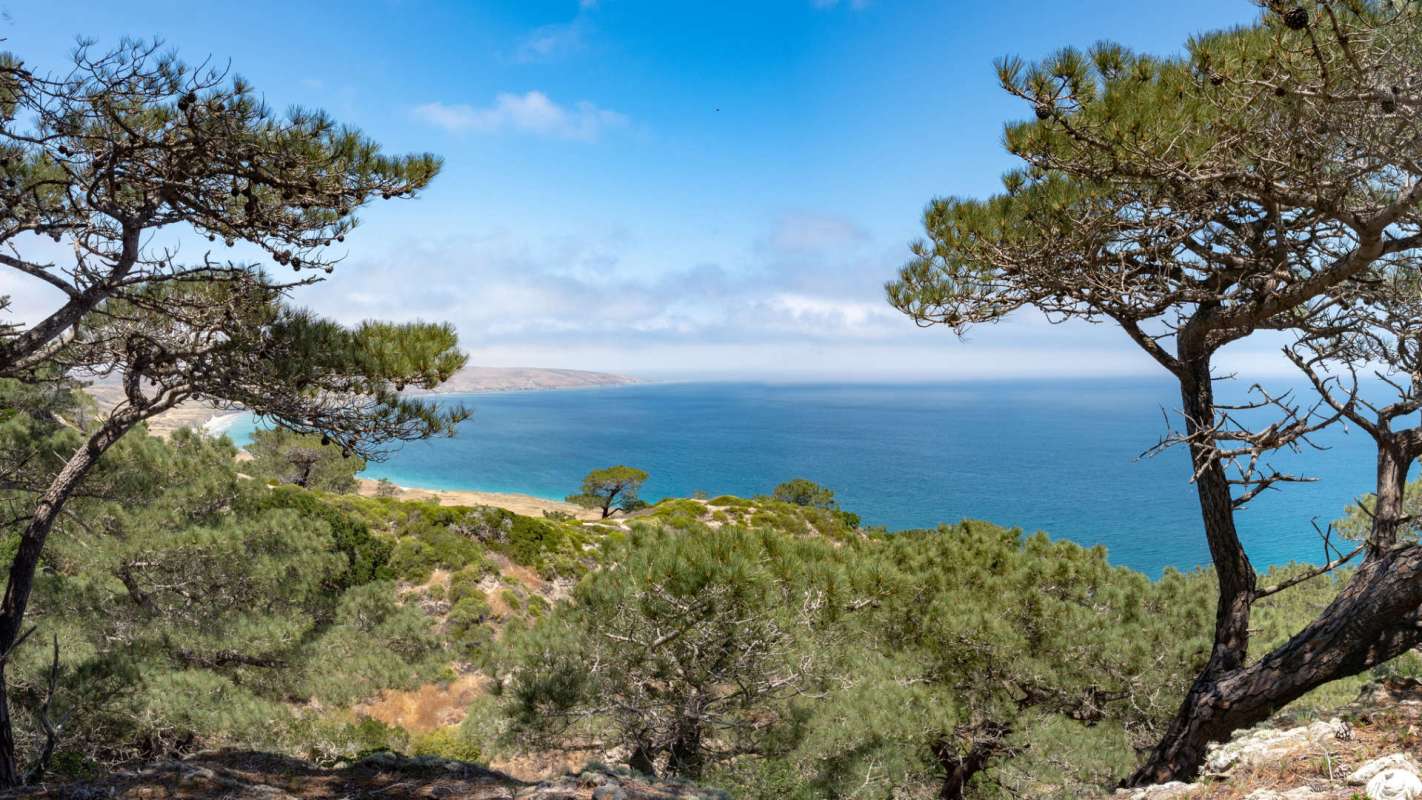
A May wildfire on Santa Rosa Island caused by people did more than scorch an isolated stretch of California coast.
It may also have set in motion a devastating die-off in one of the rarest pine populations on the planet, putting at risk an ecosystem that exists nowhere else.
What happened?
Early findings indicate the blaze reached a critically endangered Torrey pine grove after burning more than a third of the wildlife-rich island, which lies about 26 miles off the Southern California mainland in Channel Islands National Park.
Only 2% of that grove escaped the fire, National Park Service spokesperson Ana Cholo said, and federal estimates project that 60-80% of the trees will die, CNN reported.
The blaze was the largest in the park's history.
"Because Torrey pines are not well adapted to fire, even low-severity burns may result in delayed mortality," Cholo told the outlet. "A detailed assessment is underway, and the full extent of impacts may not be known for at least a year."
TCD Picks » Quince Spotlight
💡These best-sellers from Quince deliver affordable, sustainable luxury for all




Even before the fire, the Santa Rosa Island Torrey pine was viewed as highly vulnerable to extinction because it occupies such a small area and has a limited gene pool, per CNN.
Why does it matter?
In this harsh landscape, the pines do more than stand as a rare species. Their twisted needles catch fog and direct moisture to their own roots while also sustaining nearby plants and animals.
"Plants like this affect local water availability and can make a huge difference in terms of how much water is captured by life on the ground," Heather Schneider, director of conservation and research at Santa Barbara Botanic Garden, told CNN.
A setback for a rare population this small can echo for decades.
Dustin Wolkis of the Center for Plant Conservation said that it can shrink the genetic diversity that helps species endure disease and other environmental shifts.
"Once that genetic diversity is lost, you cannot get that back," he told CNN. "All you can do is maintain what you have."
Such ecological loss also slows progress toward a more stable future since healthier landscapes are better able to store water, support wildlife, and withstand climate stress.
What's being done?
Before the wildfire, the botanic garden had already gathered seeds from the island pines, Schneider said, and it used them to establish a conservation grove. It also has about 40 additional trees in its nursery.
"So that's a glimmer of hope — that we have a subsample of the island trees safely at our garden," Schneider told CNN.
Seeds from the Santa Rosa Island Torrey pine are also being stored by the Center for Plant Conservation and other organizations, giving researchers backups while they assess whether the burned grove can rebound on its own or will need assistance.
Scientists also think some seeds may have survived inside pine cones.
"It's a hard time to be a pine tree on Earth as the climate shifts," Schneider said, per CNN.
She added, "Time will tell, but for now, I feel hopeful about the prospect of regeneration from seed."

Get TCD's free newsletters for easy tips, smart advice, and a chance to earn $5,000 toward home upgrades. To see more stories like this one, change your Google preferences here.






