


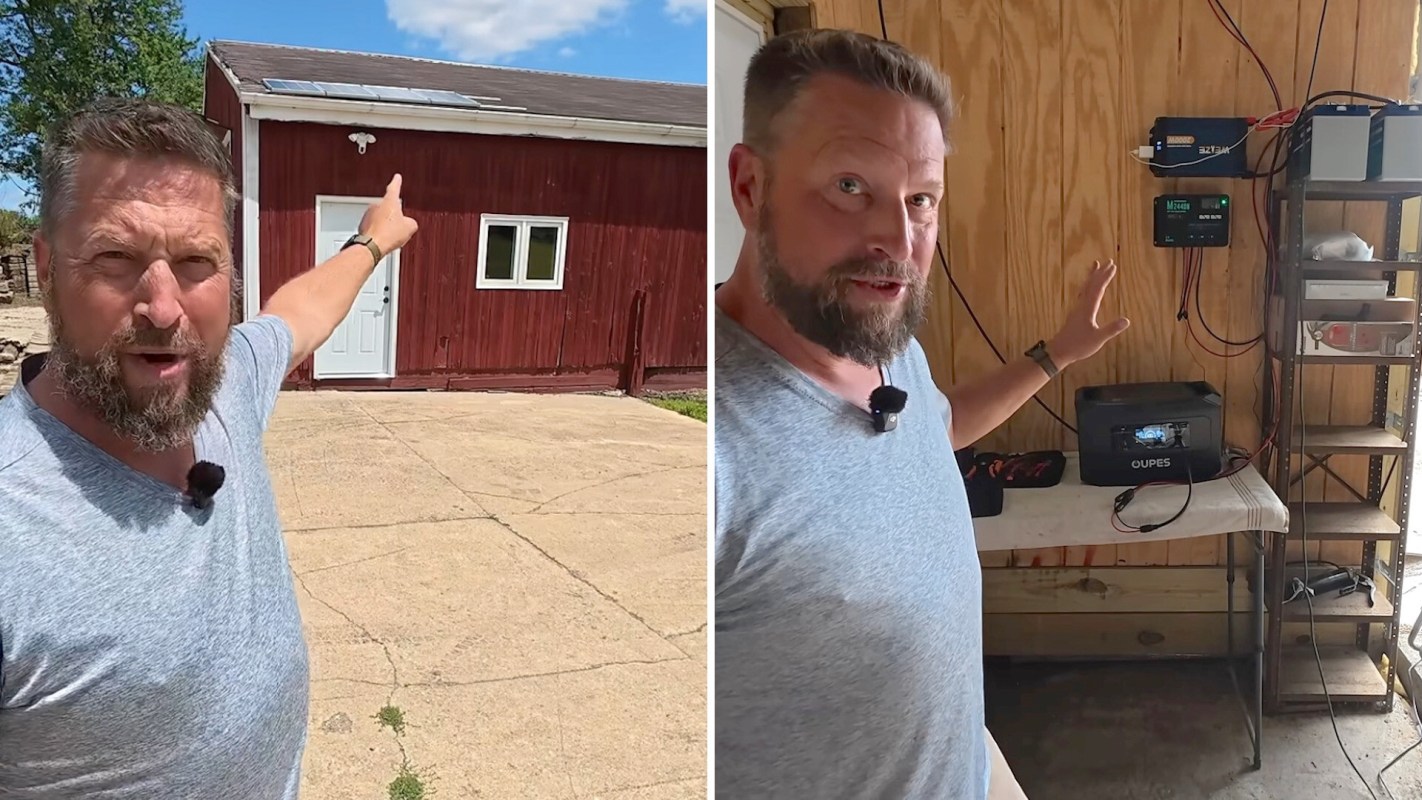
Content creator Sam of Sam's Doin Stuff (@samsdoinstuff), who had already built a 400-watt DIY solar setup for his firewood barn, decided to test a question viewers kept asking: Why not just use a portable power station instead?
After putting the two systems through real-world use, he said the commenters had a point.
What happened?
The OUPES Mega 2 Pro — which Sam said has a 2,048-watt-hour LiFePO4 battery, a 2,500-watt pure sine wave inverter, and support for up to 1,000 watts of solar input — was the off-the-shelf contender in a recent YouTube video.
In that video, Sam used it for a direct comparison with the solar system he had built for his barn.
He showed viewers how he handled the app setup, adjusted the charging settings, and linked the unit to his existing rooftop panels.
Sam also said the total cost ended up in about the same range as his DIY system once solar panels were included, which made the matchup a fair one in his view.
TCD Picks » Quince Spotlight
💡These best-sellers from Quince deliver affordable, sustainable luxury for all




One of his most practical tests focused on outage backup. Sam connected the power station to his refrigerator using its emergency power supply mode, then flipped the breaker off to imitate a blackout.
He said the unit estimated roughly 18 to 24 hours of runtime for the fridge, depending on factors such as compressor cycling and how often the door was opened.
By the end of the video, his verdict was clear: "Actually, you were. Absolutely."
Why does it matter?
The comparison gets at a question many households are asking as outages become more disruptive and people look for ways to cut dependence on the grid: Is it better to build a solar-plus-battery system piece by piece, or buy something ready to go?
The hardwired DIY route offers more permanence than flexibility. Once installed, it acts like part of the barn and keeps charging whenever the sun is out, so power is ready without extra setup.
The tradeoff is that wiring a system like that takes electrical know-how, and it is not easy to move.
Sam's own outage experience helps explain the appeal of portability. His family once lost "$400 worth of food" after a power outage while they were away, and a unit that can be moved from the barn to the kitchen or taken off-site may be more useful when the goal is protecting essentials.
Not everyone saw the all-in-one format as a clear advantage, though.
One commenter wrote, "When or if any single component breaks down, the whole thing becomes throw away," unlike a DIY system where separate parts can be replaced individually.
What can I do?
For people who want backup power without assembling batteries, inverters, and controllers themselves, a portable power station may be the simpler place to start.
Already having solar panels does not necessarily rule out a portable battery, either. Sam connected the Mega 2 Pro to the rooftop array on his barn, showing that it may be possible to keep using equipment you already own while adding a more flexible storage option.
Real-world results can also depend on settings and conditions.
Commenters pointed to battery life settings, cold-weather charging limits, and inverter power draw as factors that can shape performance.
One commenter noted, "I definitely suggest using DC adapters for devices to help out in that regard."
A refrigerator or a few critical circuits may be the most practical place to start when deciding whether backup storage is worth the cost.
"What I like the most isn't all of the features. It's the freedom," Sam said.

Get TCD's free newsletters for easy tips, smart advice, and a chance to earn $5,000 toward home upgrades. To see more stories like this one, change your Google preferences here.






