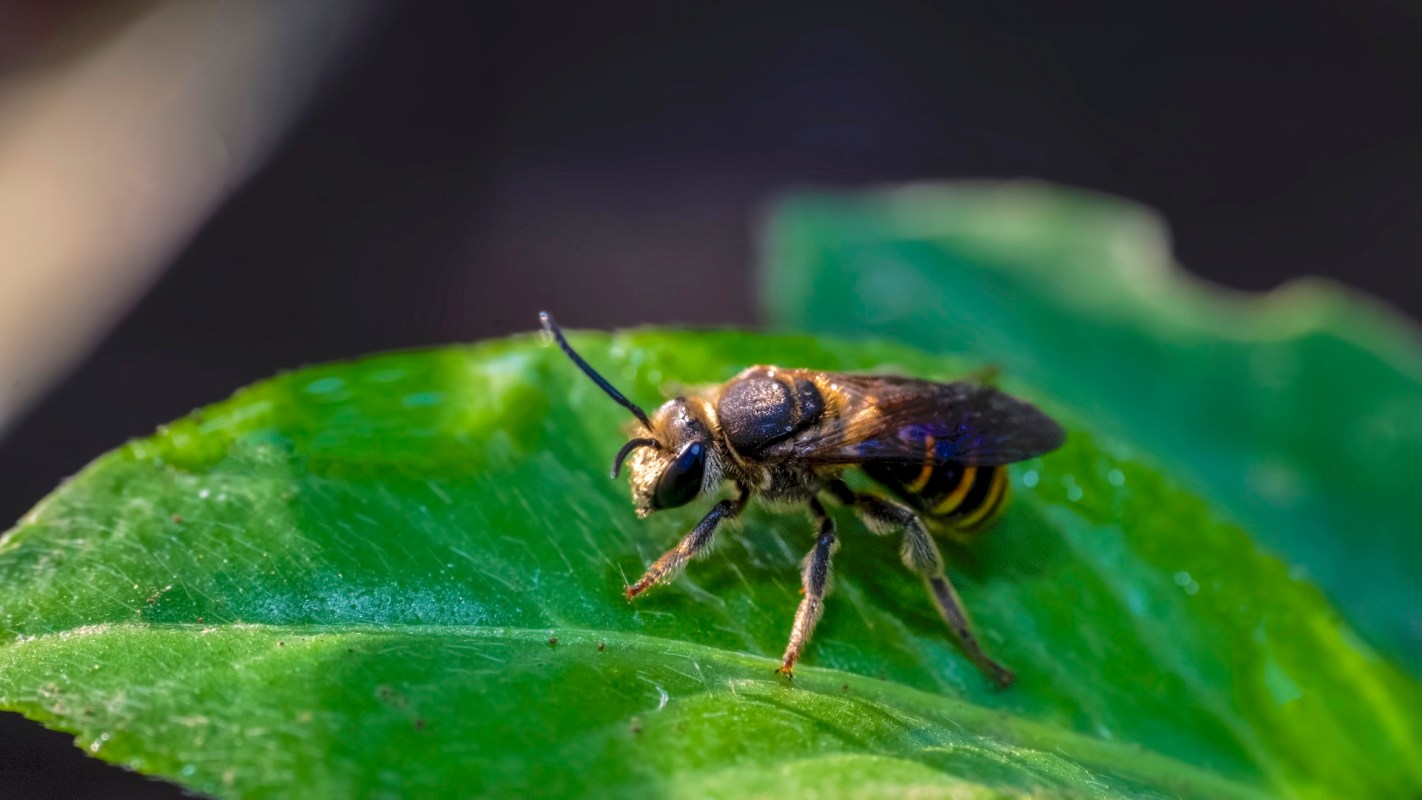
Scientists have long tied standout navigation skills to honeybees, but new research indicates magnetic sensing may be common in many other kinds of bees as well.
Researchers found magnetic properties in about 75% of the bee species they examined, an unexpectedly broad result that raises fresh questions about how common an internal compass might be in the insect world.
In a study published in Science Advances, researchers suggested that magnetism in bees may be both older and more widespread than previously assumed, Laura Russo of the University of Tennessee told Good Good Good.
What happened?
Russo and her colleagues designed the study to revisit a long-held idea about magnetoreception — the ability to detect Earth's magnetic field — in bees.
For a long time, that sense had been most strongly associated with social honeybees that nest in cavities and use complex communication to guide other bees to flowers.
Rather than tracking live bees, the team examined dried specimens representing branches across the bee family tree. They ground the insects into powder and then used a magnetometer to measure magnetic behavior. Magnetic signatures appeared in 74 of the 96 species tested.
TCD Picks » Good Store Spotlight
Get 10% off your next purchase with code TCD10




Those signals were not confined to social bees. The researchers also detected them in solitary and night-active species, as well as in bees that nest underground and bees that live above ground in hives.
Bigger bees often produced stronger magnetic signals, and social species also tended to register as more magnetic than solitary ones, but the trait showed up across the bee families included in the analysis.
With magnetism turning up so broadly, the researchers abandoned their starting hypothesis that it was mainly connected to colony life.
Why does it matter?
Bees play a crucial role in pollinating crops and wild plants, so understanding how they move through the world can help scientists better gauge ecosystem health and food production.
If many species rely on magnetic cues, even as a backup sense, that could reshape how researchers think about bee behavior and survival. That broad pattern also hints that magnetism may have existed before bees evolved.
The team also looked at other insects — including beetles, wasps, and flies — and found magnetism there too. That supports the idea that the trait could be ancient and deeply conserved.
The research suggests bees may be using more hidden tools as they forage, nest, and move through landscapes altered by human activity.
What's being done?
The researchers said the magnetic response should be treated as a sign that may correspond with magnetoreception, not as definitive proof of it. Experiments with live insects will be necessary to learn whether these magnetic particles truly help bees navigate.
The study also challenges some existing ideas about where magnetoreception might be located in the body.
Because magnetic signals turned up in several parts of the body instead of being confined to one spot, some popular theories may need to be revisited.
Russo summed up the implications, saying, "We concluded that magnetism is probably an ancient, well-conserved trait." But she also stressed the limits of the research, writing of magnetoreception in the species tested, "But we cannot prove it."

Get TCD's free newsletters for easy tips, smart advice, and a chance to earn $5,000 toward home upgrades. To see more stories like this one, change your Google preferences here.