


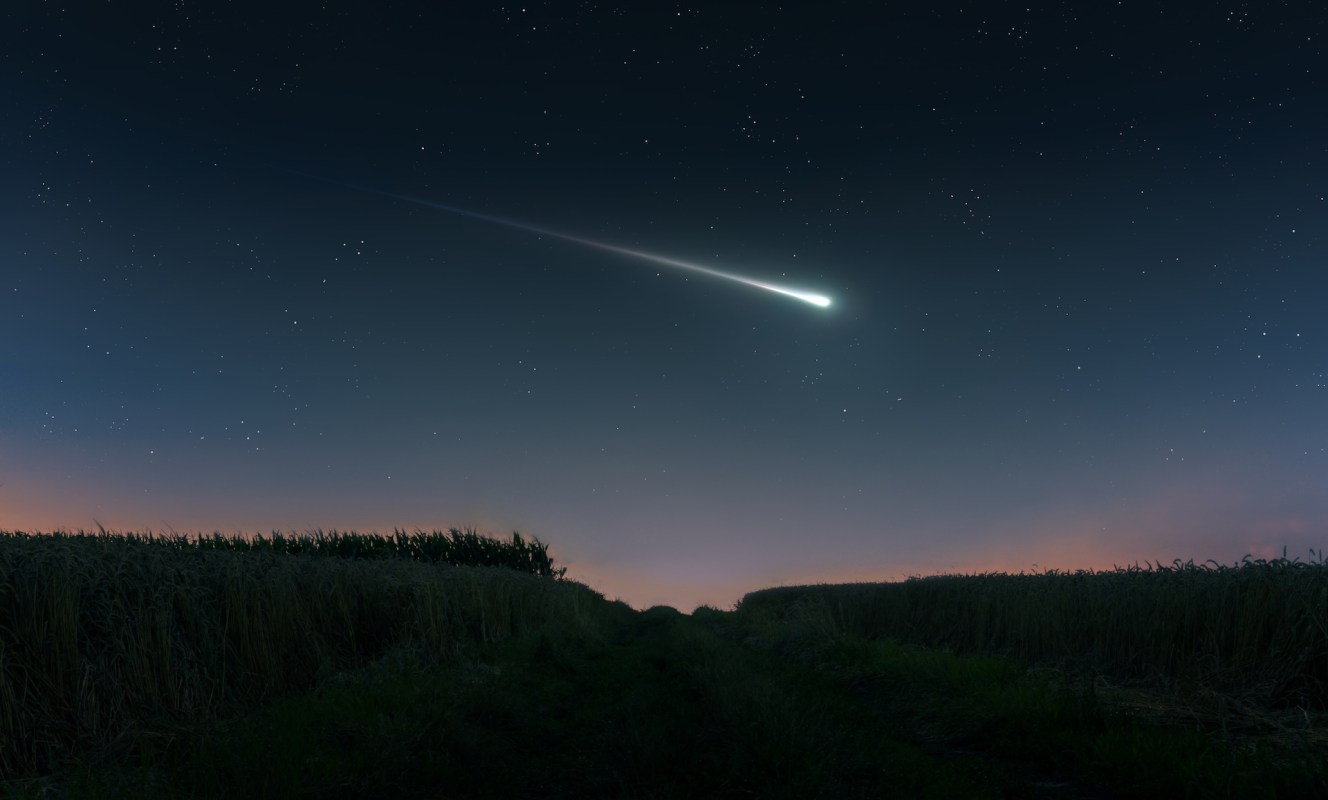
Last summer, a fireball streaked over the New York City area and ended its journey in a place few space rocks ever do: a bedroom in New Jersey.
Now, scientists say the meteorite carried amino acids and evidence that salty water once moved through its parent asteroid.
What happened?
In a study published July 15 in Science Advances, researchers identified the roughly three-pound Hillsborough meteorite — the object that punched through a house in Hillsborough, New Jersey, on July 16, 2024 — as a rare primitive kind of carbon-rich meteorite, according to Smithsonian Magazine.
One homeowner, who asked to remain anonymous for privacy, described the startling moment to Robin George Andrews at The New York Times.
"I heard an immense crash and felt the house shake," he said.
When he checked the bedroom, he added, "I open the door, and I see a hole in the ceiling above my bed."
TCD Picks » Quince Spotlight
💡These best-sellers from Quince deliver affordable, sustainable luxury for all




Lab analysis showed the meteorite is an intermediate CM1/2 carbonaceous chondrite, an especially unusual subtype. Scientists have documented 22 CM-type meteorite falls, but only two — including this one — have been classified that way.
The discovery is not proof that life was present. But researchers found a broad range of amino acids, which are components of proteins, and sodium-rich material in tiny fractures, indicating that salty water once moved through the meteorite's parent asteroid.
Why does it matter?
Because they undergo less alteration than many other space rocks, primitive meteorites can preserve chemistry from the solar system's early era.
Peter Brown, a meteor physicist at Western University in Canada who was not involved in the study, told The New York Times, "These are primitive meteorites. They resemble the chemistry that made the planets."
Meteorites of this carbon-rich type may also help researchers understand how some of Earth's water arrived here.
The sample was recovered quickly and carefully, giving scientists a clearer picture of what the meteorite was carrying through space.
More broadly, the find adds to evidence that asteroids can preserve records from the solar system's earliest days.
What's being done?
After the impact, the homeowners contacted Mike Hankey, an amateur astronomer affiliated with the American Meteor Society, and he helped guide the preservation of the fragments. Using gloves, aluminum foil, and glass containers, they protected the pieces before lab testing began.
Scientists then used microscopes and chemical analysis to study the meteorite's makeup. Cameras across New Jersey had also recorded the fireball, allowing researchers to reconstruct its path and estimate where it came from.
The team believes the object likely came from 163 Erigone, an asteroid in the belt between Mars and Jupiter, before later collisions eventually sent a fragment toward Earth at about 32,000 miles per hour.
"Thanks to the homeowner's quick reaction, these are the most pristine CM1/2 [meteorite pieces] we know of," study co-author Peter Jenniskens, a planetary astronomer at the SETI Institute, said in a statement.
Study co-author Danny Glavin, who works in astrobiology at NASA's Goddard Space Flight Center, also said he was struck by "the complexity of amino acids and other organic compounds."

Get TCD's free newsletters for easy tips, smart advice, and a chance to earn $5,000 toward home upgrades. To see more stories like this one, change your Google preferences here.






