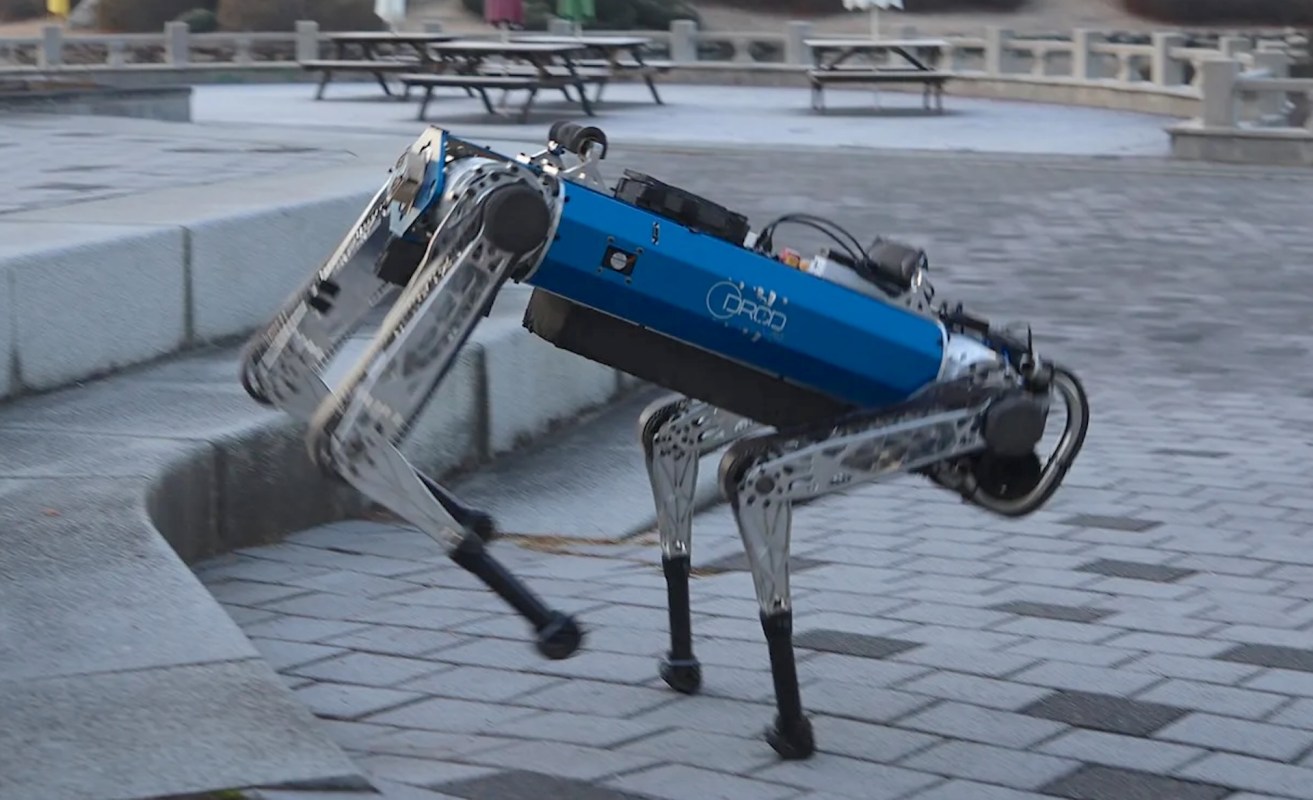
A four-legged robot from South Korea is offering a glimpse at how machines could soon navigate the world with the agility of animals.
Instead of relying on one fixed pace, the robot analyzes the ground ahead and changes how it moves on the fly.
That means it can trot carefully across rough terrain, then switch to a faster bounding gait when it needs to clear larger obstacles.
What's happening?
Hound, a 100-pound robot developed by researchers at the Korea Advanced Institute of Science and Technology, can run across forests, stairs, and obstacle courses without needing a human operator to direct every step for it. Using cameras and lidar, the machine reads the terrain ahead and decides in real time whether to use a steady trot or a faster bound.
The team detailed the system July 15 in Science Robotics, as Live Science reported. During tests, Hound completed a 0.7-mile route across a university campus and a 0.2-mile forest trail where roots, logs, and slick leaves made travel harder.
Researchers trained Hound with APT-RL, or action pretrained transformer-based reinforcement learning. According to Live Science, that process began with 180,000 brief movement sequences made in a simple simulation, adding up to about 15.5 hours of motion and taking only around eight minutes to generate.
TCD Picks » Good Store Spotlight
Get 10% off your next purchase with code TCD10




Live Science reported that, in one indoor trial, the robot reached 9.5 mph while getting over a 2-foot obstacle, and it also jumped down a three-step staircase.
Why does it matter?
One of the biggest hurdles in robotics is building machines that can handle the messy, unpredictable environments where people might actually need them. Smooth lab floors are one thing. Wet leaves, uneven trails, broken stairs, and storm-damaged areas are another.
A robot that can quickly adapt its movement could take on dangerous tasks first. Systems like Hound could help inspect hazardous sites, carry sensors or supplies over rough ground, or assist search-and-rescue crews in places where wheeled machines would get stuck.
That kind of mobility could be especially useful after disasters. If a robot can move through debris, climb steps, or cross fallen branches without constant remote control, emergency teams may be able to assess damage more quickly while reducing risks to human responders. For instance, German engineers developed an AI-powered semi-autonomous robot that helps disaster responders transport heavy equipment through dangerous terrain.
Rather than repeating a single preprogrammed motion, Hound responds to what its sensors detect and selects a way of moving that fits the terrain. That is a step toward robots that are more practical in the real world.
What's being done?
The researchers focused on a common weakness in legged robotics: switching between gaits can be as hard as mastering the gaits themselves. When that transition is slow or awkward, robots can stumble or fall, so the team trained a single AI model to handle both movement styles as well as the transitions between them.
Live Science said the reinforcement-learning phase placed Hound in simulated stair sets, stepping stones, hurdles, gaps, and uneven terrain. The system also had to cope with 3D surfaces and unexpected obstacles, eventually clearing a log even though that exact move was not part of the training data.
As Live Science noted, the current version mainly supports forward travel and just two gaits, leaving sharp turns, sideways motion, and crawling as future goals for the team.
The work points toward more practical helper robots for inspections, emergency response, and other difficult jobs in places that are unsafe for people.

Get TCD's free newsletters for easy tips, smart advice, and a chance to earn $5,000 toward home upgrades. To see more stories like this one, change your Google preferences here.