


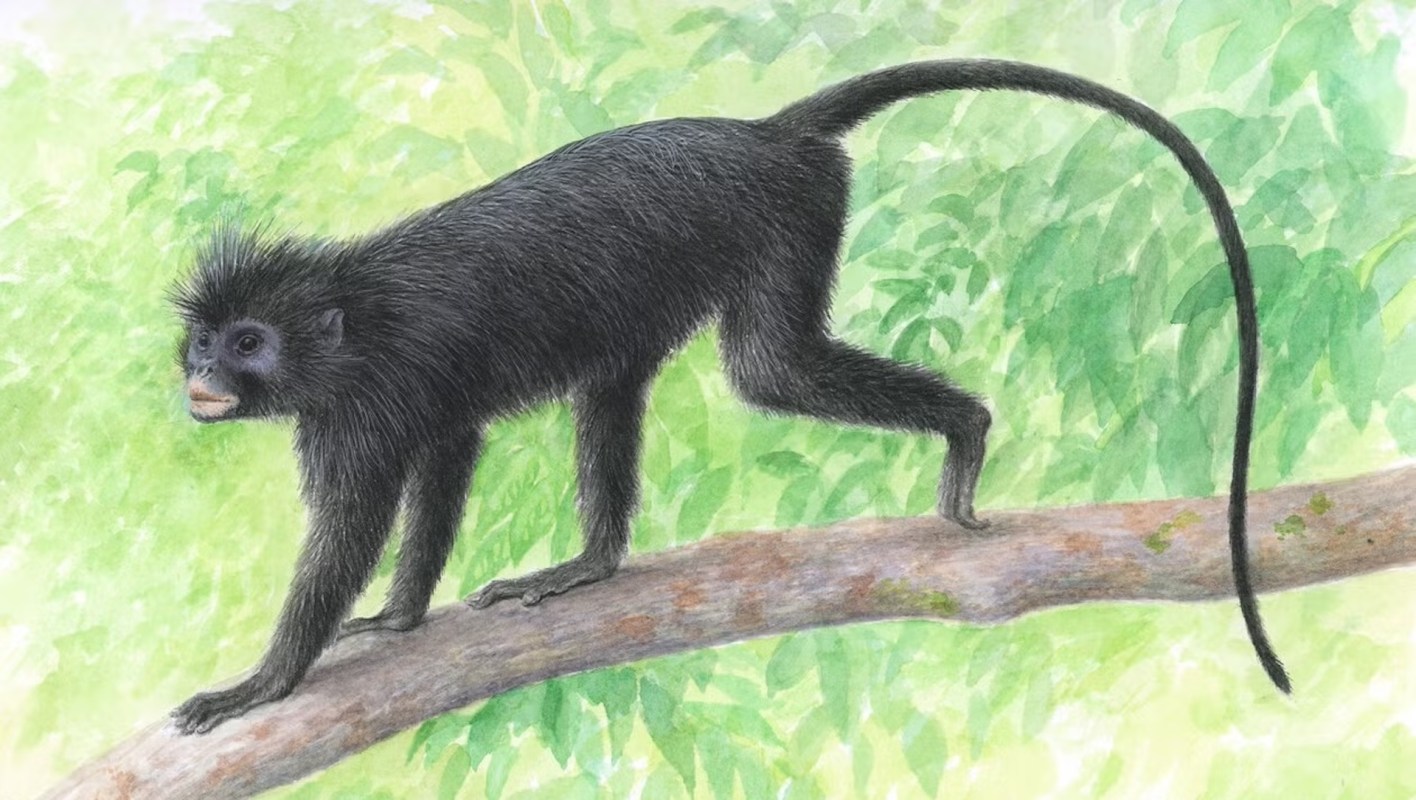
Scientists have formally recognized a little-seen monkey from the high forest canopy of the Democratic Republic of Congo as its own species, a type of discovery that is exceedingly unusual in primate research.
The monkey, known locally as Likweli, is only the fifth African monkey species to be identified in the last 75 years, reported YaleNews.
What happened?
In a study published July 15 in PLOS One, an international research team that included Yale scientists concluded that Likweli, a black monkey with a long tail, is a separate species: Colobus congoensis.
Several kinds of evidence supported that finding. Researchers pointed to the monkey's small size, orange-cream coloring around the mouth and nose, and white markings under the tail, while genetic, physical, and vocal data all supported the same conclusion.
"Our team evaluated multiple datasets that all reached the same conclusion: Likweli is a distinct species of Colobus monkey we haven't seen before," said Julia Arenson, a Yale postdoctoral fellow and study coauthor.
From 2018 through 2022, the researchers logged 114 sightings across roughly 1,700 square kilometers in and around Lomami National Park.
TCD Picks » Quince Spotlight
💡These best-sellers from Quince deliver affordable, sustainable luxury for all




They usually encountered the monkeys in groups of about six, but getting records of them was challenging because they remain high in dense canopy.
Why does it matter?
New primate species are rarely documented, and this one may already require urgent protection.
Researchers said Likweli lives in a limited area, has a small population, and faces increasing threats from hunting and human encroachment. Identifying it as a distinct species could help inform conservation planning in a region already recognized for extraordinary biodiversity.
Protecting species like this can also help preserve healthy forests that support nearby communities through cleaner water, more stable ecosystems, and stronger natural resources.
Study lead author John Hart credited Congolese field experts with making the work possible, saying, "The discovery and documentation of the Likweli never would have happened without our team of Congolese explorer naturalists."
The team also interviewed residents in 52 villages within and near the monkey's range. People in only eight of those villages were able to accurately describe the species.
What's being done?
The researchers say Likweli should be classified as endangered, a move that could bring more attention and resources to protecting habitat in Lomami National Park and nearby buffer zones.
"Only after 10 years of exploring the Lomami Forest did we have enough clear views and convincing photos to allow us to say that there was yet another new monkey," said conservation biologist Terese Hart.
The work was carried out with authorization from the Congolese Institute for Nature Conservation, and specimens confiscated from hunters are now kept at the Yale Peabody Museum for additional scientific study.
"This is a rare discovery with significant conservation implications," said professor of anthropology Eric Sargis. "Documenting new primate species like Likweli and Lesula illustrates the incredible biodiversity in this region and points to the importance of Lomami National Park and other conservation efforts in protecting that diversity."

Get TCD's free newsletters for easy tips, smart advice, and a chance to earn $5,000 toward home upgrades. To see more stories like this one, change your Google preferences here.






