


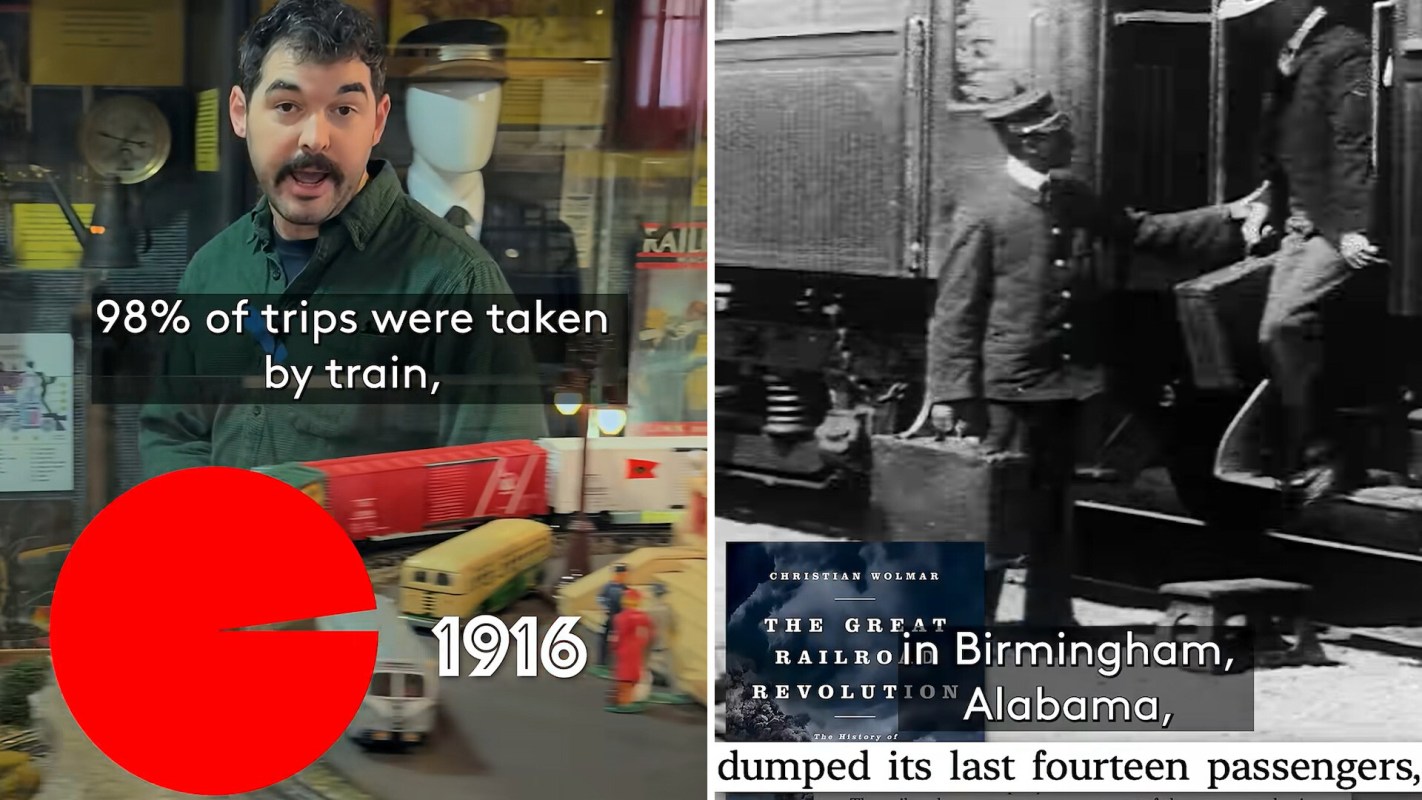
A growing number of Americans are questioning whether the country really fell out of love with trains, or were riders pushed away?
What's happening?
In a YouTube video, Climate Town (@ClimateTown) made the case that America's passenger rail decline "wasn't a natural consumer preference — it was engineered."
After the introduction of the Interstate Commerce Commission in 1887 to stop railroad bosses from exploiting customers, government regulations were introduced to force rail companies to run routes even if this came at a financial loss. However, as the content creator details, to get out of running the service, rail companies would make train journeys worse for customers so that they simply wouldn't turn up.
According to the video, parts of the experience were gradually stripped away. Dining cars disappeared, station bathrooms were removed, and some routes were set at hours that made taking the train far less practical.
In that telling, the familiar idea that Americans simply preferred cars gets the sequence backward. Service worsened first, riders fell away after that, and the lower ridership was then used to defend further neglect.
The comments reflected that frustration.
TCD Picks » Quince Spotlight
💡These best-sellers from Quince deliver affordable, sustainable luxury for all




One commenter wrote, "Greed destroys everything. Always has. Always will."
Why does it matter?
When reliable passenger rail disappears, people are pushed toward driving whether they want to or not — and that can mean higher household transportation costs, more traffic, more pollution, and fewer options for people who cannot or do not want to own a car.
It also affects the way communities are built. Car-centered development spreads homes, jobs, and stores farther apart, making daily life more difficult without a vehicle and increasing the amount of land and infrastructure devoted to roads and parking.
That has consequences for neighborhood design, air quality, and climate pollution.
One viewer wrote: "I did the math and taking the train for the bare minimum number of 'mid-distance ' trips I would take would be more expensive than using an EV. But it would be cheap enough to justify if Amtrak sold a pass they already offer elsewhere for my specific route. Not to mention the lack of metro despite the European density of my area, in short, I would ride the train but they won't let me! Amtrak, let me ride you!"
What's being done?
Across the U.S., transit advocates, cities, and some state agencies are pushing to expand rail service, improve local transit connections, and adopt land-use rules that make it easier to build walkable neighborhoods around stations.
A commenter suggested starting in the suburbs, arguing that a "short term solution that can be achieved in 9 years" is to "convert the suburbs each in some degree into streetcar-suburbs," then add tram infrastructure to car-dominated streets and connect areas through dedicated rail corridors.

Get TCD's free newsletters for easy tips, smart advice, and a chance to earn $5,000 toward home upgrades. To see more stories like this one, change your Google preferences here.






