


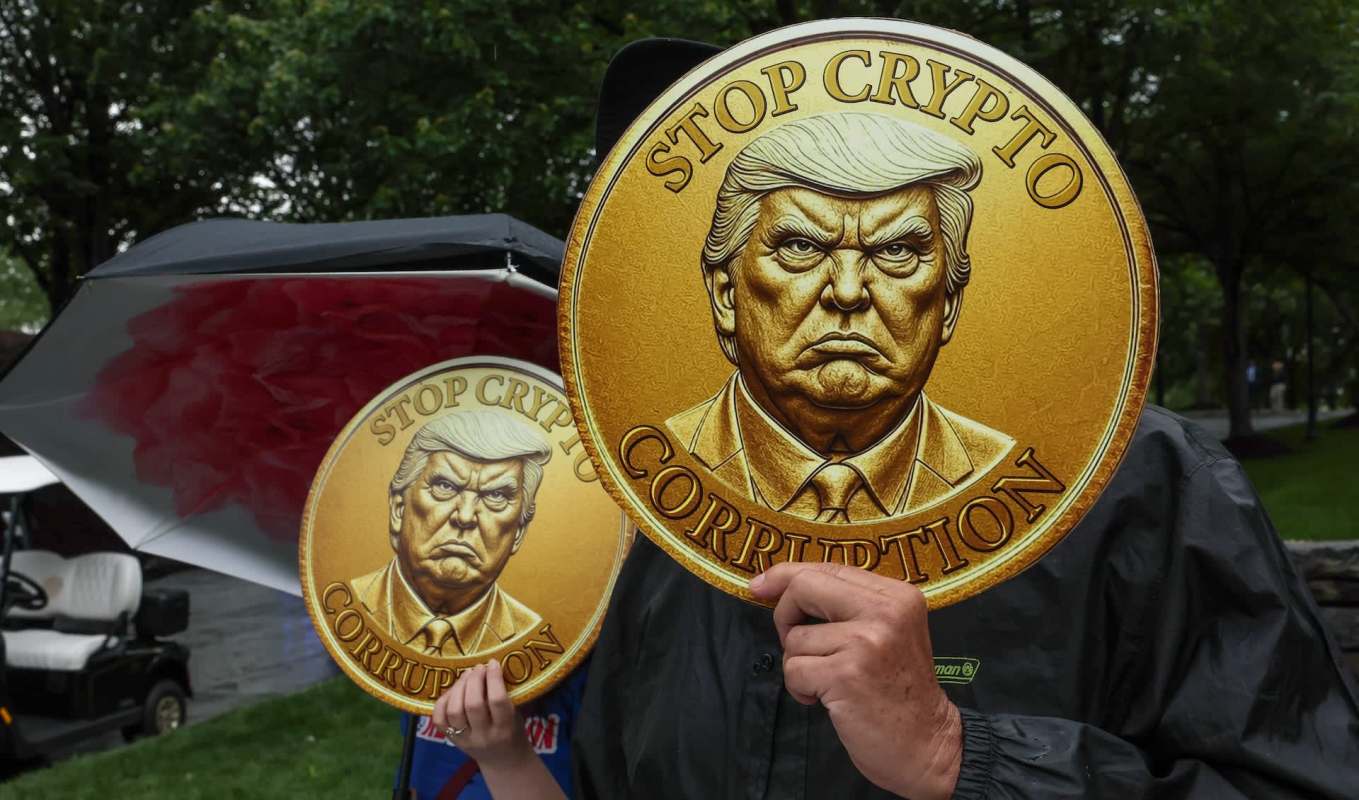
President Donald Trump recently promoted a federally backed savings plan for newborns. At the same time, a very different Trump-branded cryptocurrency product was drawing scrutiny after producing a massive payday for his family while many buyers saw their holdings plunge.
What happened?
According to The Independent, in 2025, Trump and his sons made more than $1.4 billion from their crypto business, more than he earned in any other year across his various ventures. The biggest sources were World Liberty Financial and the $TRUMP meme coin.
World Liberty Financial was launched in fall 2024 after Trump had spent months courting the crypto industry. Four days before the inauguration, a company linked to an Abu Dhabi royal quietly bought nearly half the firm, sending $187 million to Trump family entities, The Independent reported.
Many of the people who bought into Trump's meme coin did not see similar gains. Citing crypto data firm Nansen, The Independent reported that roughly two-thirds of buyers lost money, with total losses reaching $3.81 billion by late June. The coin itself was introduced that same week and used the fist-pump image after the Butler assassination attempt, reportedly bringing in about $636 million for Trump.
Cryptocurrencies and especially meme coins tend to function more like stock investments than as pure currency, and when something like $TRUMP gains and then loses value, the creators and early adopters profit by selling their stake when it is around its peak value. While there is more nuance to it, ultimately those who bought at a higher price then see their investment lose value if this happens, effectively having given their money to those who cashed out.
Fatime Elrgdawy, a 29-year-old software project engineer from California, said one $2,000 $TRUMP purchase had dropped to less than $120 within five months. Separately, another analysis summarized by The Independent found that 85% of buyers in one World Liberty token were underwater.
TCD Picks » Quince Spotlight
💡These best-sellers from Quince deliver affordable, sustainable luxury for all




Why does it matter?
The situation raises questions about how closely federal policy and personal business interests are overlapping. As The Independent noted, the administration has eased oversight of the crypto sector and pulled back from some anti-scam enforcement, while crypto companies were also among the biggest donors in the 2024 election cycle.
While crypto as a broader technology can offer some legitimate benefits, meme coins are especially volatile and often reward early insiders far more than later-arriving retail traders.
Some crypto operations, particularly those tied to energy-intensive mining, can also consume massive amounts of electricity. At the same time, parts of the industry are shifting toward lower-energy systems and renewable-powered projects.
What can I do?
Celebrity coins and politically branded tokens are speculative, not savings vehicles. If losing the entire amount would disrupt a budget, that money likely does not belong in a meme coin.
Warning signs include concentrated ownership, vague disclosures, promises of quick gains, or a project whose value depends mostly on a famous name. Those factors can amplify losses when large holders sell.
Crypto exposure can be kept small, on reputable platforms, with projects that have clearer utility and lower-energy systems where possible. For most households, emergency savings, retirement accounts, and diversified index funds remain more reliable ways to build financial stability.
The administration currently says there are "no conflicts of interest." Trump, for his part, told CNBC, "I could know about it. I didn't. There's nothing illegal. There's nothing wrong with it."

Get TCD's free newsletters for easy tips, smart advice, and a chance to earn $5,000 toward home upgrades. To see more stories like this one, change your Google preferences here.






