


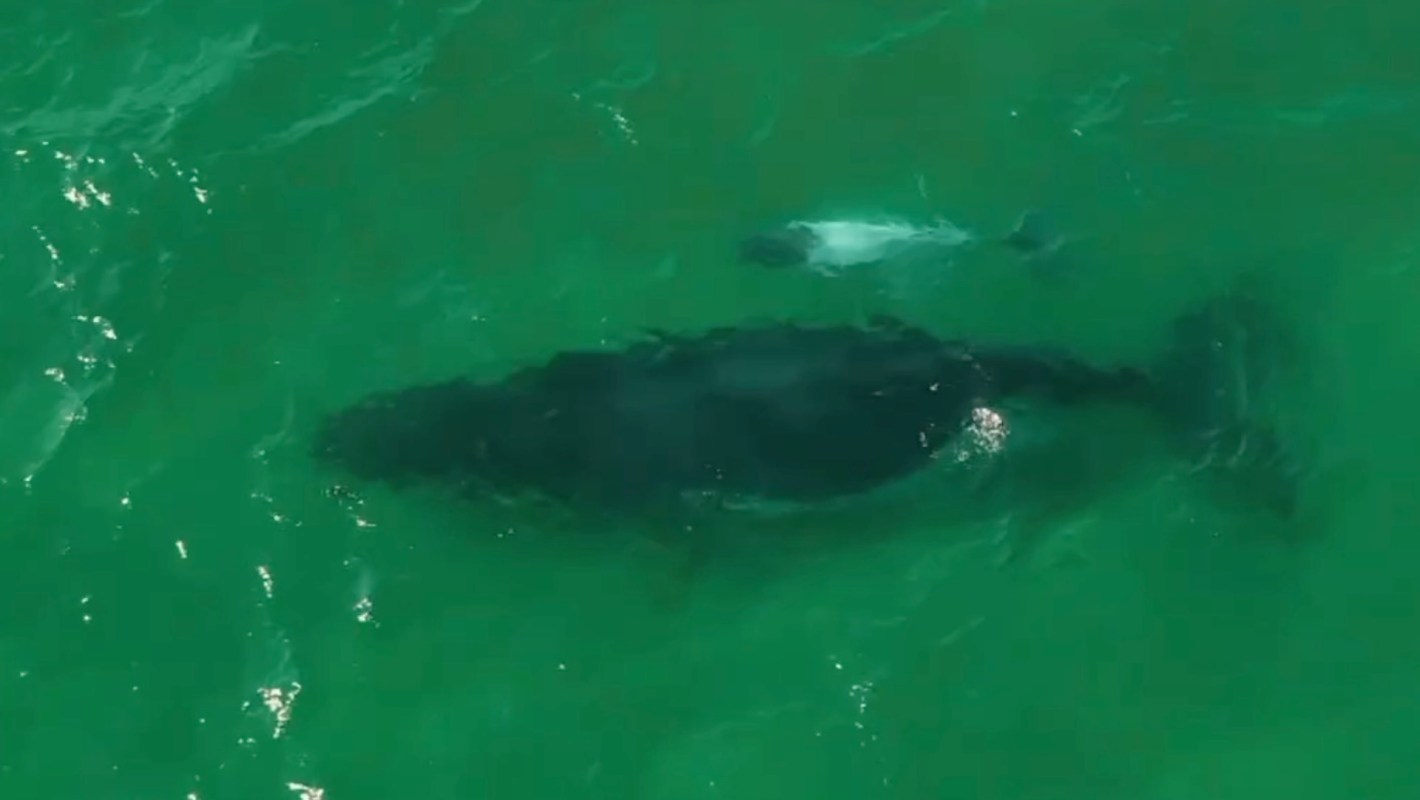
Scientists were given an unusual research opportunity when whale watchers off New South Wales and Queensland reported a mostly white humpback calf, an animal experts think may be among only a small number of its kind in the Southern Hemisphere.
Its striking appearance drew comparisons to Migaloo, the famous all-white humpback first spotted in Byron Bay in 1991, and also raised questions about whale genetics, migration, and conservation.
What happened?
According to the Australian Broadcasting Corp., footage captured the calf swimming beside its mother near Cabarita Beach, and it was seen again the next day near Minjerribah, or Stradbroke Island, roughly 62 miles farther north.
The Commonwealth Scientific and Industrial Research Organisation's Eva Plaganyi said the calf's coloring was so unexpected that she needed a moment to understand what she was seeing.
"We saw that this calf was almost all white, so looking almost like a small iceberg floating by against the dark of the female whale," she told the ABC. "So really exciting sighting and not something I've seen in my four decades of whale watching."
Researchers believe the calf may be leucistic, a condition that causes reduced pigmentation but allows some color to remain along with normal dark eyes. That differs from albinism, which typically results in a completely white body and pink or reddish eyes.
TCD Picks » Quince Spotlight
💡These best-sellers from Quince deliver affordable, sustainable luxury for all




The sighting also renewed interest in Migaloo. "In order to manifest or show this colouration, it is quite a rare genetic mutation … so it is possible Migaloo fathered this particular calf, or there could be another reason for this genetic mutation," Plaganyi told the ABC.
Still, scientists cautioned they will not know whether the calf is leucistic — or whether it is related to Migaloo — unless genetic testing is carried out.
Why does it matter?
The sighting gave scientists a rare opportunity to learn more about whale genetics, migration patterns, and survival.
Because distinctive animals are easier to identify over time, researchers may be able to track this calf's movements across vast distances more easily than they could those of other whales.
That information could support stronger conservation efforts, especially as humpback whales move in busy coastal waters shared with boats, drones, and swimmers.
Whale watching is a major seasonal attraction in Australia, and unusual sightings can build support for scientific research, tourism rules, and ocean protection that benefits both wildlife and coastal communities.
"This one definitely makes people look twice," Macquarie University whale scientist Vanessa Pirotta told the ABC. "It is very white on top, so you'd be forgiven to think the whole thing is white until you see the darker bits."
What's being done?
Scientists encouraged the public to document the calf as it continues north toward warmer waters near Hervey Bay.
"They are so highly visible that we can draw on citizen science to help us understand and answer questions about the whale," Plaganyi told the ABC. "A distinctive whale like this means all along the coast people can spot the whale and log those observations."
Pirotta said, "The non-scientists helping out is really wonderful because they can spot things that we don't see, and through social media, we can document whale movements."
Whale watching guidelines require swimmers and drones to stay 328 feet away, while vessels must remain 984 feet away. For whales that are predominantly white, the rules are even stricter: Boats and other watercraft must remain 1,640 feet away, and aircraft must stay 2,001 feet above them.
Pirotta said the calf could turn up far beyond Australia. "It may be that this whale was born here but could turn up in New Zealand waters or even off Brazil. You never know," she added.

Get TCD's free newsletters for easy tips, smart advice, and a chance to earn $5,000 toward home upgrades. To see more stories like this one, change your Google preferences here.







