


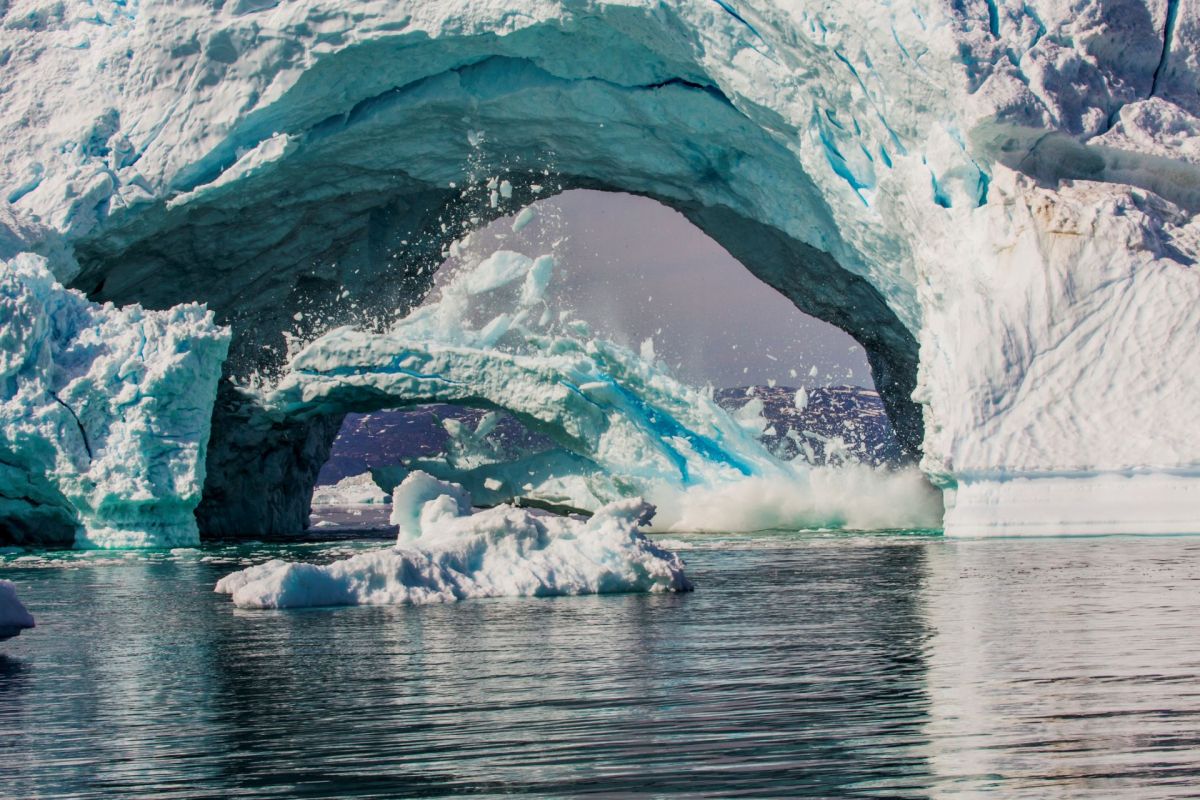
Two suddenly drained lakes appear to have sent a jolt through one of Greenland's most famous glaciers, triggering a rapid chain reaction of 25 calving events in just two hours.
What happened?
Between July 21 and July 24, 2022, two supraglacial lakes emptied on West Greenland's Sermeq Kujalleq — better known as the Jakobshavn glacier — and a study has found the glacier showed an unusually dramatic response downstream, according to Earth Institute at Columbia University (via Phys.org).
To reconstruct what happened after the lakes drained, researchers led by Adrien Wehrlé of the University of Zürich combined satellite imagery with terrestrial radar. The study was published in the journal Nature Geoscience.
Although the lakes were about 13 kilometers (8 miles) south of the glacier and roughly 25 kilometers (16 miles) from its front, the meltwater pulse still reached the bottom of the ice stream.
The glacier's response unfolded quickly after that water reduced friction at its base and sped up the ice.
Researchers found that the resulting pulse moved more than 16 kilometers downstream in about four hours, traveled at roughly 2.5 miles per hour, and persisted for around 24 hours before reaching the glacier terminus and triggering a burst of calving.
TCD Picks » Quince Spotlight
💡These best-sellers from Quince deliver affordable, sustainable luxury for all




What followed was not a single dramatic break but a rapid sequence of failures. Over two hours, the glacier calved 25 times in succession, and the largest of those events ranked among the biggest seen during the team's 13-day field campaign, which recorded 125 calving events in total.
Why does it matter?
The study connects a surface-melting event far upstream with major ice loss at the glacier's front. It suggests that water draining from lakes on top of the ice sheet can destabilize a tidewater glacier many miles away without the disturbance fading as it travels.
That is especially important in Greenland, where warmer temperatures are expected to create larger surface lakes and possibly more frequent drainage events. Sermeq Kujalleq is already among the world's fastest-moving and most active glaciers, releasing upward of 50 gigatons of ice into the ocean each year.
Greenland is already a major contributor to rising seas. Per Phys.org, its ice sheet accounts for about 20% of current global sea level rise, and the rate of melting there is now nearly seven times what it was 30 years ago.
For coastal areas, the effects can include increased flood risk, greater saltwater intrusion into freshwater supplies, and mounting pressure on homes, roads, and local economies. The loss of stable ice conditions also threatens Arctic wildlife habitat and marine ecosystems.
What's being done?
Scientists are getting better at tracking these events in real time. In this case, pairing satellite observations with on-the-ground radar allowed researchers to map a direct cause-and-effect chain from lake drainage to glacier acceleration to calving, which could improve future ice-loss forecasting.
Better data can help refine flood maps, infrastructure planning, and coastal resilience efforts as warming reshapes polar ice.
Jonathan Kingslake, a glaciologist at Lamont-Doherty Earth Observatory, part of the Columbia Climate School, said that "while general statements about the frequency and magnitude of similar events may be hard to make, there is probably going to be more drainage and melting in the future."
He added, "The ocean is warming, so its warmer currents cause ice sheet loss as a secondary element."

Get TCD's free newsletters for easy tips, smart advice, and a chance to earn $5,000 toward home upgrades. To see more stories like this one, change your Google preferences here.






