


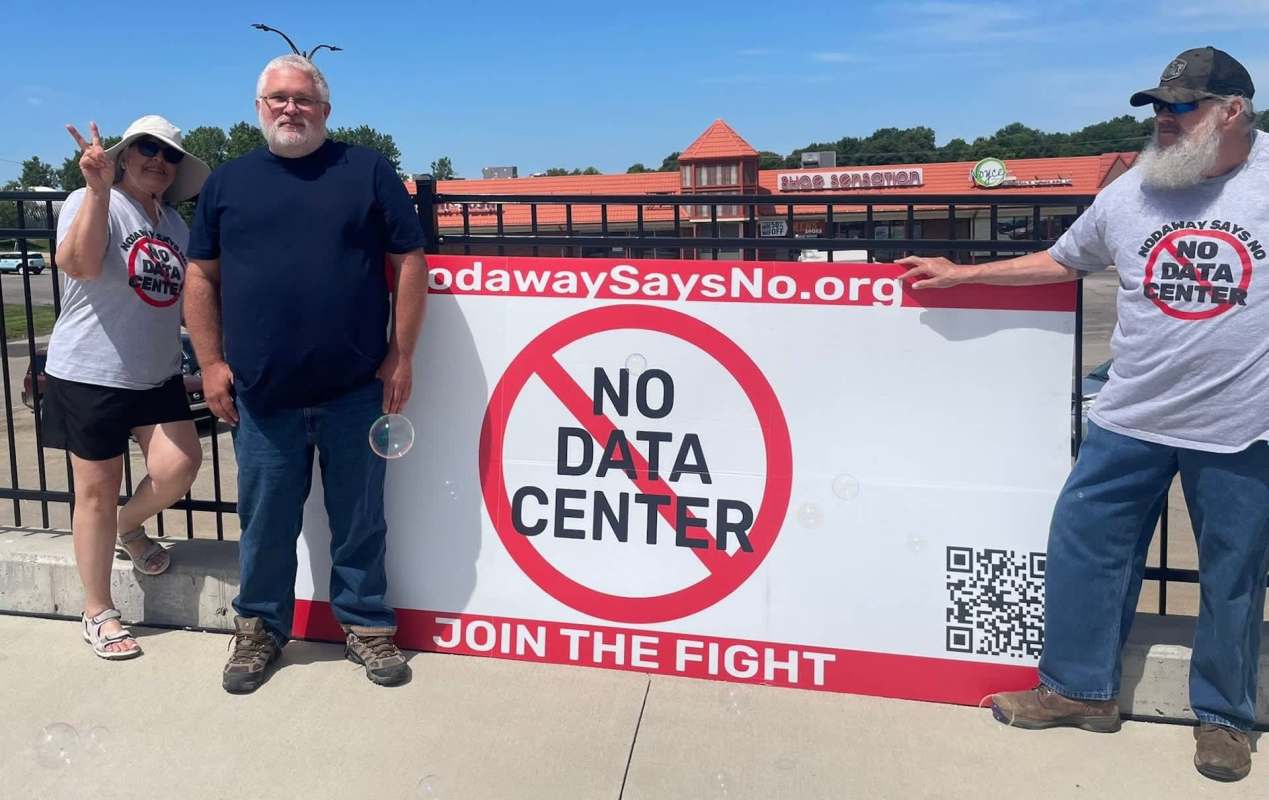
Election season in northwest Missouri has produced an unusual sign in front yards: "No data center."
Near Maryville, plans for a $6.3 billion AI complex have drawn widening resistance from local farmers, residents, and the mayor.
In Nodaway County, opponents say the proposal raises bigger questions than a single construction project, including water use, power consumption, local control, and the future of a rural area.
What happened?
According to The Northwest Missourian, Scale Microgrids is expected to determine by the end of the month whether it will proceed with White Cloud Acres, a proposed development south of Maryville.
As that decision approaches, opposition has organized quickly. Residents formed the coalition Nodaway Says No, and a petition started by Northwest Missouri State University senior Carter Strauch, a lifelong resident of Nodaway County, has drawn more than 7,000 signatures in roughly two months.
Across the county, residents have put the slogan on yard signs with no extra explanation: "No data center."
TCD Picks » Quince Spotlight
💡These best-sellers from Quince deliver affordable, sustainable luxury for all




People have filled public meetings, staged protests, and challenged local leaders on issues including water consumption, tax abatements, transparency, and Missouri's limited rules for data-center construction.
County resident Holly Caviness, who helps organize the group, told the outlet, "I think there is a reason there's a lot of public distrust."
Blue Missouri Executive Director Jess Piper said, "People don't have to use AI, but people have to have clean water to drink."
Although the location under consideration is beyond Maryville's boundaries, Mayor John McBride has said he does not support the plan. "I can tell you what my response is … I'm not in favor of this going forward."
Strauch framed the issue as one that goes beyond party politics, saying, "It doesn't matter what side of the political spectrum you are on, like, this is very much a bipartisan issue, and people just need to come together and make a change for good."
Why does it matter?
For many locals, the fight comes down to basic resources.
According to the Environmental and Energy Study Institute, a large data center can require up to 5 million gallons of water per day. Maryville's treatment plant, by comparison, provides 2.5 million gallons daily to the city and surrounding rural communities.
Neighbors near the proposed site have also raised concerns about wastewater, potential PFAS pollution, noise, light, and possible harm to livestock and wildlife.
Within five miles of the project site, farmer Tim Schafer says his land could be affected. "We know that low-level sound affects livestock, as far as their production and their reproduction."
Schafer also worries that the project would alter the rural landscape where he has spent his life farming.
The debate also highlights AI's growing connection to the energy grid. AI can help utilities forecast demand, improve efficiency, and better integrate solar and wind power.
But the large data centers that support those systems can also drive up electricity and water use, put pressure on local infrastructure, increase costs for communities, and raise concerns about surveillance, security, and other unintended consequences.

Get TCD's free newsletters for easy tips, smart advice, and a chance to earn $5,000 toward home upgrades. To see more stories like this one, change your Google preferences here.






