


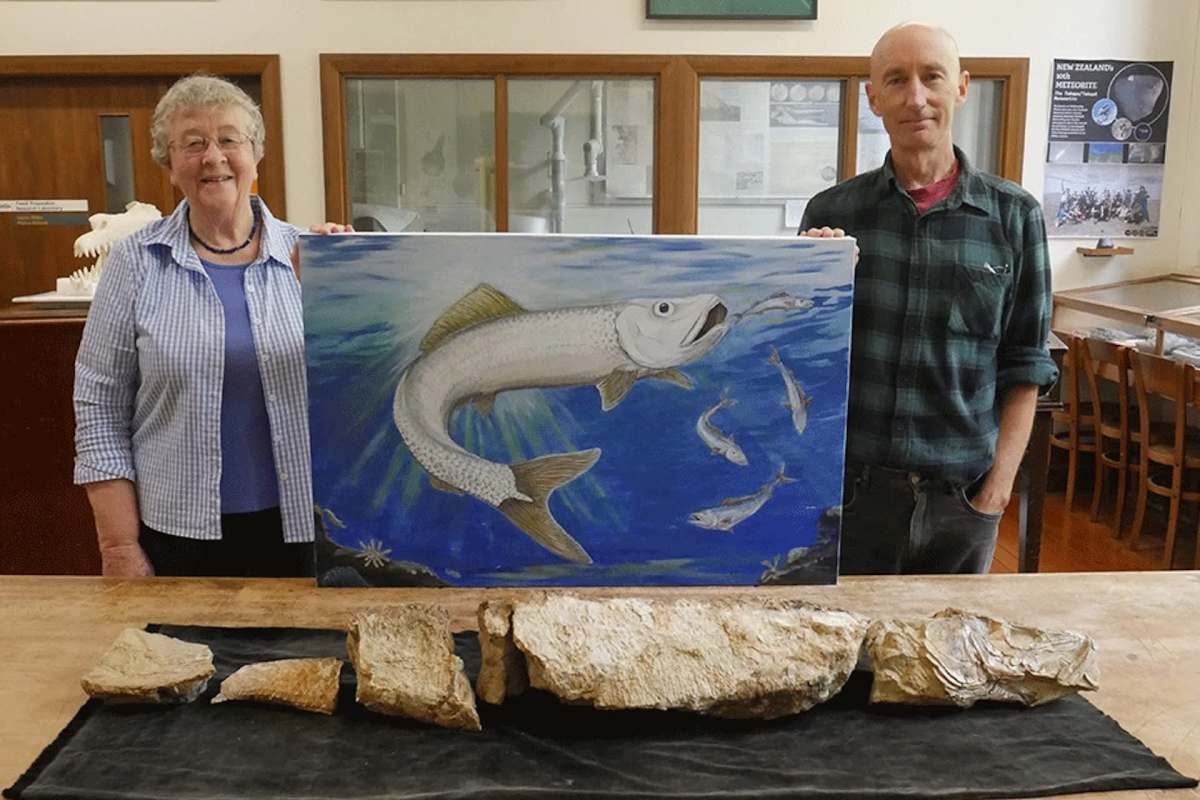
Researchers have finally identified a strange mummified fish fossil from New Zealand after a late paleontologist's field notebooks resurfaced. The fossil fish was discovered on a remote cliff nearly 30 years ago.
But now, with the original collector's long-lost notebooks found, scientists can fully understand an ancient predator unlike anything else in New Zealand's fossil record.
What happened?
Back in 1999, paleontologist Dr. Richard Köhler was exploring Pitt Island in the Chatham Islands when he noticed a preserved fish fossil set high in a cliff above Waihere Bay, ScienceDaily reported.
Because the spot was so difficult to access, Köhler walked about two miles back to Flowerpot Bay to borrow a ladder, then returned and removed the fossil in several huge blocks.
When the specimen reached the University of Otago's Department of Geology, researchers quickly recognized it as an unusual and significant find.
"It was quite unlike any other fish fossil known from Aotearoa, New Zealand," Daphne Lee, a professor at the University of Otago, told ScienceDaily.
TCD Picks » Quince Spotlight
💡These best-sellers from Quince deliver affordable, sustainable luxury for all




The 1.2-meter mummified fish was identified as a tarpon, a major predator no longer found in New Zealand waters. Its long body, heavy scales, powerful tail, and upward-facing mouth indicate it likely swallowed smaller fish whole.
Even so, the research could not be completed because key geological information about the discovery site was missing, and Köhler died in December 2020.
That changed in early 2025, when one of Köhler's children visited the department to seek photographs of his father and met with Lee. The visit led the family to donate Köhler's field notebooks, including notes from the original Pitt Island expedition.
Why does it matter?
With the notebooks, researchers were able to document the fossil's origin properly and finally publish the study in the New Zealand Journal of Geology and Geophysics. It was the first report of this predatory fish from the Paleogene in Aotearoa, about 55 million years ago.
The fish has been named Ikawaihere koehleri, honoring both Köhler and Waihere, the place where it was found.
The discovery also suggests that ancient marine ecosystems around New Zealand included top predators similar to modern tarpon.
What are people saying?
Describing the impact of the donated notebooks, Lee said, "This enabled us to get enough specific locality information to prepare a Fossil Record Form and to scientifically catalogue the fossil."
Mike Gottfried, another professor at the University of Otago, called it a "remarkable fossil."
"It greatly expands our knowledge of the evolutionary history of tarpons, and it preserves unique and unusual features in exquisite 3D detail," he said.
Lee called the completed paper "a fitting tribute" to Köhler, late University of Otago professor, Ewan Fordyce, and late fossil preparator Andrew Grebneff, who all worked on the research.

Get TCD's free newsletters for easy tips, smart advice, and a chance to earn $5,000 toward home upgrades. To see more stories like this one, change your Google preferences here.






