


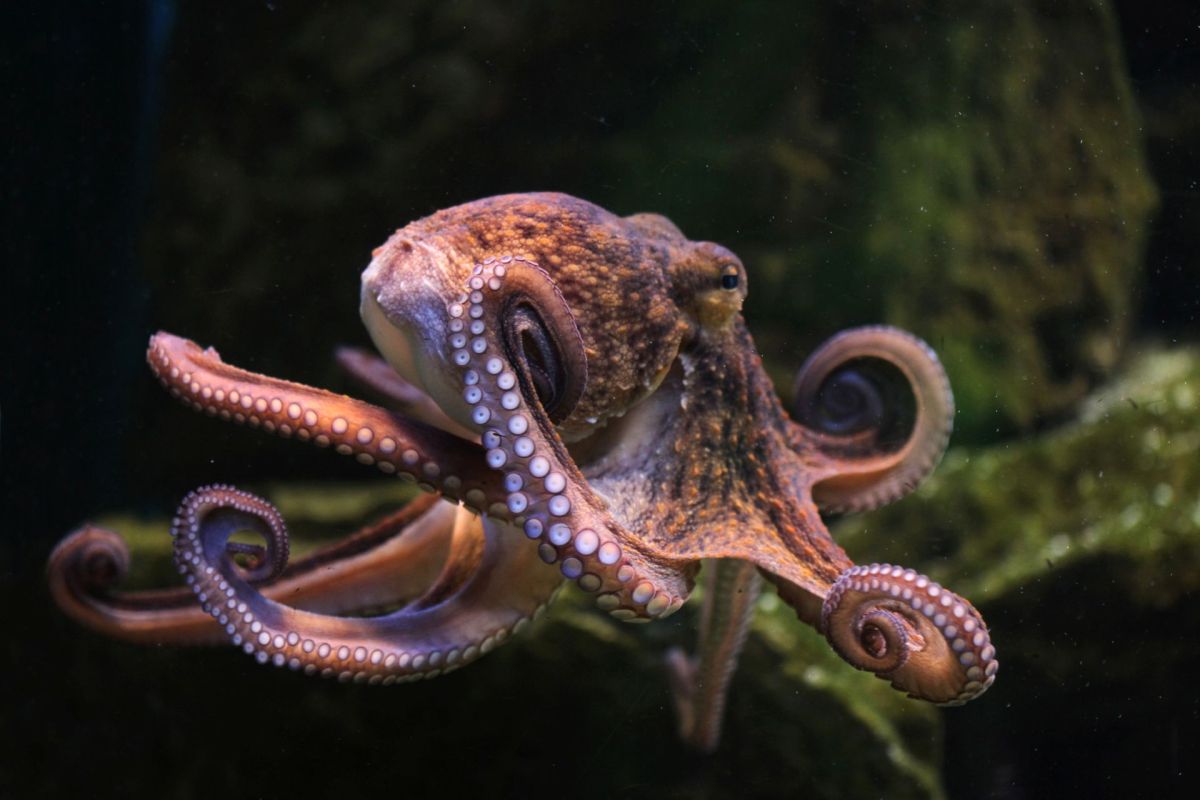
Octopuses have added another astonishing skill to their résumé. In a first-ever feat for the animals, octopuses used mirrors to spot prey they couldn't see directly.
The results, published in Current Biology, suggest these animals can use reflections to work out where hidden prey is, marking the first recorded example of that ability in an invertebrate.
At Dartmouth College, researchers tested three California two-spot octopuses to see whether they could be taught to use a mirror to find prey, highlighting a notably sophisticated kind of spatial reasoning in an animal already famous for its intelligence, per Discover Wildlife.
The octopuses first had to learn not to strike at a reflected crab. In the first round of training, all three initially moved toward the mirror image instead of the real prey. However, after roughly 10 to 12 trials each, they learned to go to the actual crab.
The researchers then made the task harder. To rule out the possibility that the octopuses were simply smelling or touching the prey, they used virtual crab images positioned so they could be seen only in the mirror.
A correct choice earned the octopus a real live crab. Across the tests, the animals selected the right location 73% of the time, far above random chance, and all three got their first test right.
TCD Picks » Quince Spotlight
💡These best-sellers from Quince deliver affordable, sustainable luxury for all




This kind of mirror use is a form of mediated perception, understanding that a reflection provides useful information about the real world rather than simply presenting a confusing image. That ability has previously been associated mostly with vertebrates.
Because octopuses are so distantly related to humans, their apparent ability to handle mirrored spatial cues raises the possibility that complex cognition can arise separately in very different branches of life when similar problems need to be solved.
For a predator, tracking its position relative to the surrounding environment is useful, and the findings hint that octopuses may depend on a map-like representation of space. Researchers said more study is needed to determine whether the animals solved the task through simple associations or through a deeper mental representation of their environment.
Cognitive neuroscientist and one of the study's authors, Peter Tse, told Discover Wildlife, "We don't enter the world knowing how to use a mirror but learn how to use a mirror. Octopuses can also learn how to use a mirror to infer where things are in the world."
Tse also pointed to what the behavior could reveal about octopus minds: "Our work suggests that octopuses might also have internal maps, an internal representation of space."

Get TCD's free newsletters for easy tips, smart advice, and a chance to earn $5,000 toward home upgrades. To see more stories like this one, change your Google preferences here.






