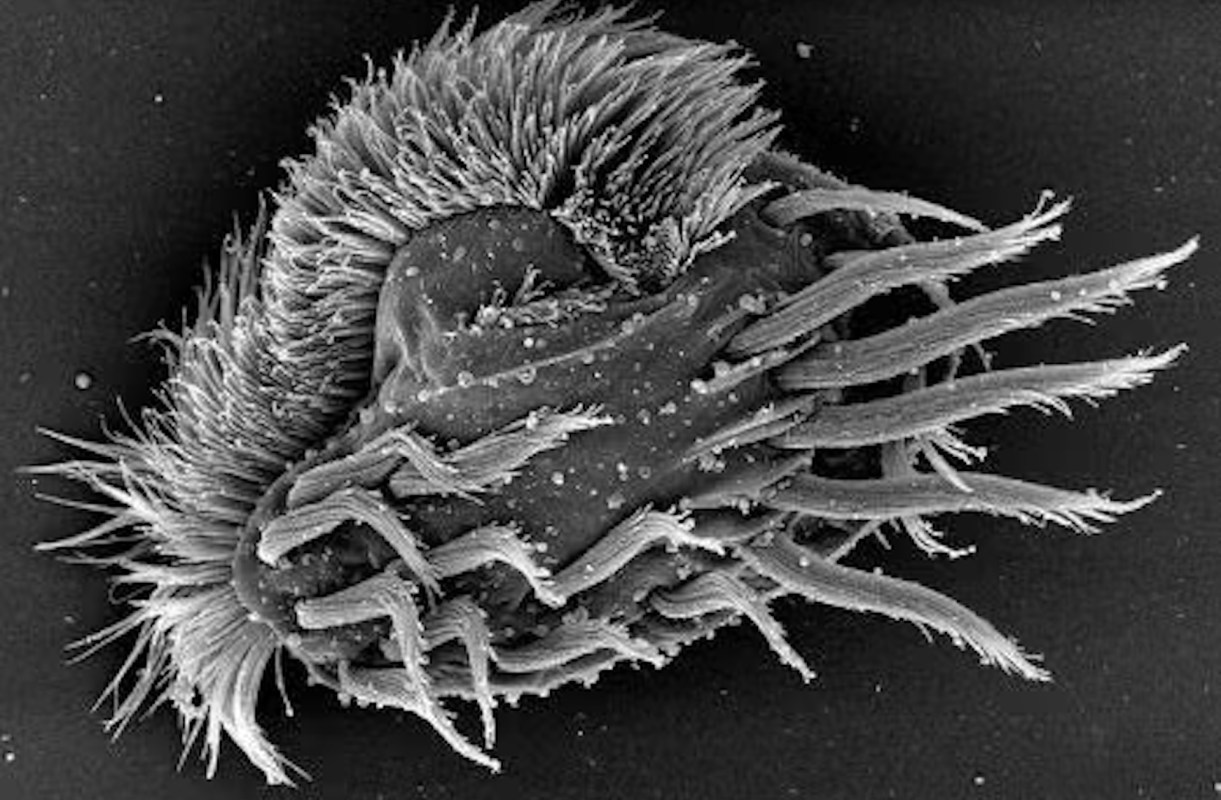
Scientists report a newly identified microbe that can abruptly become a cannibalistic "supergiant," preying on members of its own clone, as Sci News details.
The discovery indicates that a single cell can adopt a radically different body plan and way of life, which is something more often linked to animals than to microscopic organisms.
What happened?
Sci News reported the organism is a newly identified ciliate species, Euplotes gigatrox, found in seawater filtration equipment on the Caribbean island of Curaçao.
Most cells in this species feed on bacteria, but a small fraction of genetically identical individuals spontaneously turn into oversized predators that chase and swallow their smaller relatives whole, the researchers revealed in the study.
Their findings were published in Proceedings of the National Academy of Sciences, where they shared that these supergiants can exceed twice the length of ordinary cells. They also develop a wider shape, a larger mouth, and can eat at a rate of about one cell every 10 minutes, per the scientists.
That is unusual even among ciliates, which are already known for their elaborate structures, as Sci News asserted.
TCD Picks » EDF Spotlight
💡EDF's Vital Signs newsletter delivers stories about game-changing solutions close to home and around the world




"Supergiant formation represents a tradeoff," lead author Dr. Ben Larson told the outlet. "These cells become better hunters but worse swimmers, shifting their trophic niche from feeding on bacteria to exploiting a completely different type of prey,"
Why does it matter?
The findings suggest microscopic life can undergo more complex developmental shifts than first appears.
The change affects movement as well as diet. Normal cells can walk and swim, whereas the supergiants mostly crawl in circles that suit hunting prey on surfaces and tumble awkwardly if they get knocked loose.
Researchers found that this shift appears to be tied to a deeper developmental program. Supergiants had a distinct gene-expression profile, and even cells that reverted to normal temporarily retained a unique molecular signature.
This appears to represent a separate biological state rather than a cell simply growing larger.
Such shifts can help scientists better understand how cells change form and function, a core question in biology with implications for evolution and for how living systems adapt under stress.
Researchers also found that supergiants make up less than roughly 5% of the population, suggesting a built-in survival strategy in which only a few cells shift roles when food conditions change.
What are people saying?
The intriguing behavior adds more insight into the complexity of single-cell organisms.
"This is a single cell doing something we usually associate with the development of animals," Larson told Sci News. "It expands our picture of what single-celled organisms are capable of."
That can allow scientists to glean insights not just from animals, but from what Larson described to Sci News as "a completely different branch of the tree of life."

Get TCD's free newsletters for easy tips, smart advice, and a chance to earn $5,000 toward home upgrades. To see more stories like this one, change your Google preferences here.
Cool Picks