


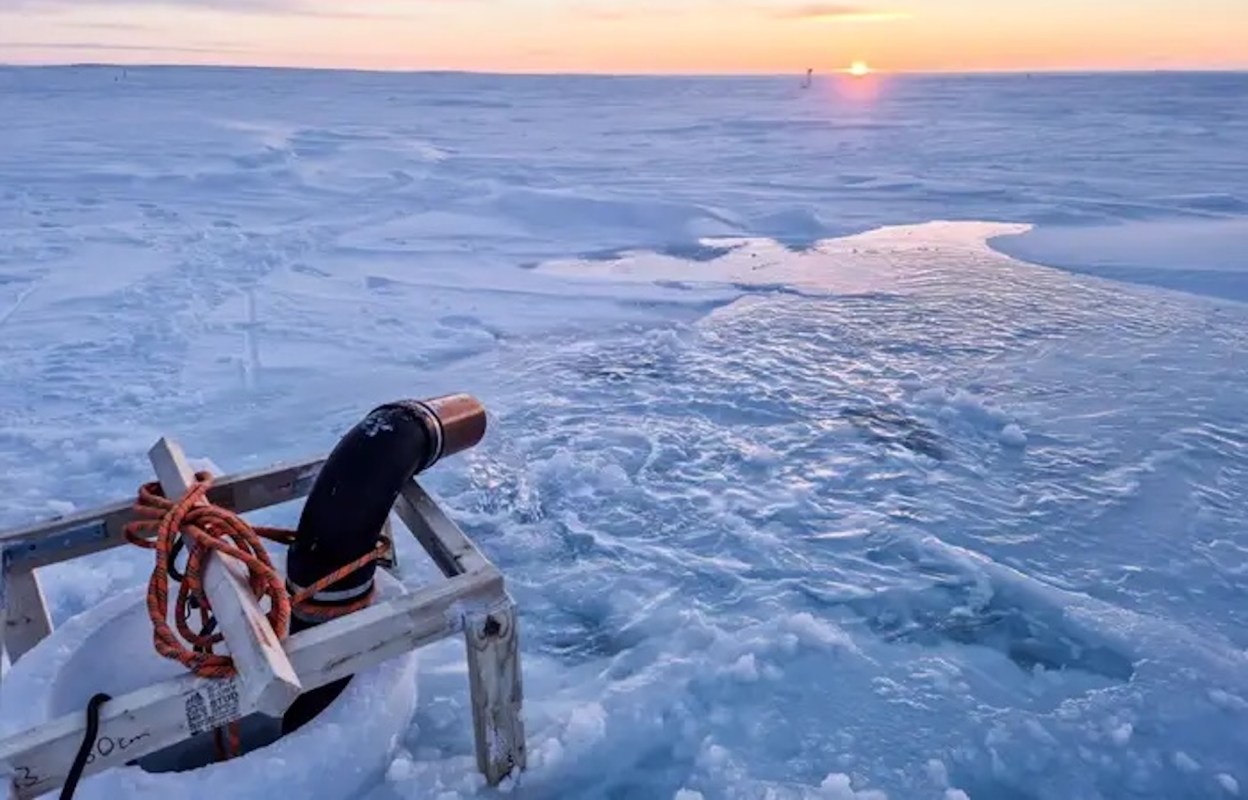
Researchers are testing a cold-climate technique on Arctic sea ice: drilling through the ice, bringing seawater up to the snow-covered surface, and allowing it to freeze to help the ice survive longer into summer.
Even limited success could matter if it keeps more of the Arctic's bright, reflective ice in place and reduces the amount of solar heat the darker ocean absorbs.
What's happening?
Field experiments in Canada and Norway during 2024 and 2025 were designed to find out whether flooding Arctic sea ice with seawater can slow its loss, New Scientist reported.
The concern is global in scale. New Scientist reported that Arctic sea ice could disappear entirely by the 2030s, taking away one of Earth's major natural buffers against warming.
In Norway's Svalbard archipelago, Dutch company Arctic Reflections conducted a study by spreading seawater over snow covering over 16,000 square feet of sea ice. Within a few days, the slushy layer froze, raising total ice thickness from about 2.9 feet to 3.8 feet.
A much larger Canadian experiment, led by Real Ice near Cambridge Bay in the Northwest Passage, treated roughly 2,690,000 square feet. Some locations were thickened twice, and temperature sensors suggested the treated ice may have remained in place about 7 to 10 days longer than the historical average.
TCD Picks » Quince Spotlight
💡These best-sellers from Quince deliver affordable, sustainable luxury for all




In Norway, the thicker ice started "rotting" later, but it still did not melt any later than untreated ice. Christian Haas of the Alfred Wegener Institute summed up the uncertainty, saying, "Yes, the ice is getting thicker, but how it delays the eventual disappearance of the ice remains an open question."
Why does it matter?
Arctic sea ice sends more sunlight back into space, while open water absorbs that energy instead. If that reflective cover can be kept around longer, it could slightly reduce warming and affect ecosystems, coastlines, and weather patterns far beyond the Arctic.
Over time, slower warming could mean fewer climate-related disruptions, including pressure on infrastructure and higher costs linked to extreme heat, storms, and environmental damage.
Still, scientists say thicker ice should not automatically be treated as better ice.
As seawater freezes, it expels salt as brine, which can leave the resulting ice warmer, saltier, and more porous. Haas warned, "It's not about the thickness, but about the quality of the ice."
According to New Scientist, researchers are also examining possible effects on wildlife, including ice algae, seals, and polar bears. They have also warned that large-scale geoengineering efforts could pull attention from the urgent need to reduce planet-heating emissions.
What's being done?
Both teams are pressing ahead with more trials while scientists model whether thickening sea ice could have value on a wider scale. The effort is supported in part by a £9.9 million (roughly $13 million) U.K. government grant covering fieldwork and modeling.
Researchers are also looking at whether the approach could be most useful in especially important locations, such as straits where sea ice often drifts south and melts, New Scientist reported. Real Ice has also suggested that underwater drones might eventually help refreeze sea ice across much larger areas.
According to New Scientist, both teams said the treated ice became brighter, and satellite images showed Real Ice's sites as pale areas bordered by blue meltwater. Andrea Ceccolini of Real Ice said, "We were contributing to reducing the heating of the planet."

Get TCD's free newsletters for easy tips, smart advice, and a chance to earn $5,000 toward home upgrades. To see more stories like this one, change your Google preferences here.






