


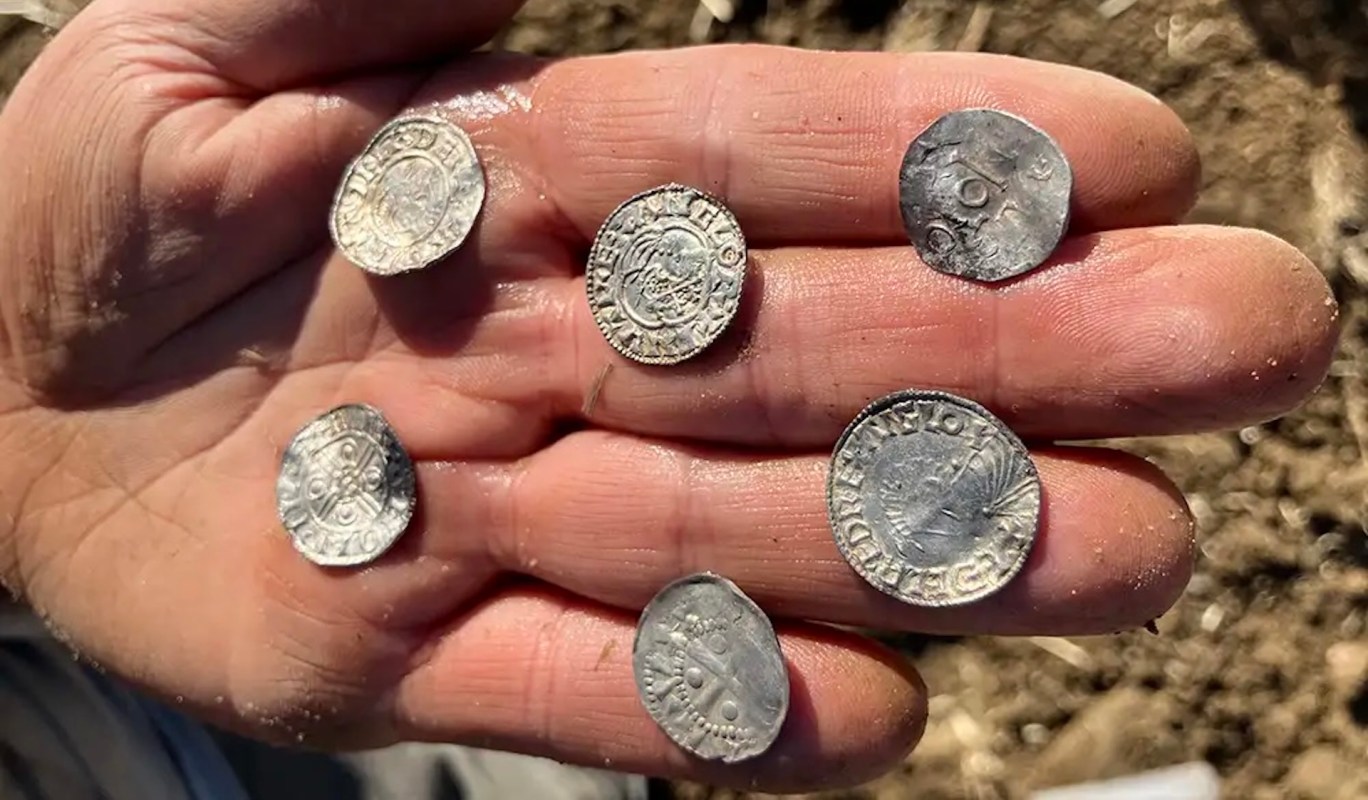
What began as a promising find for two hobbyists in Norway has become one of the year's most remarkable archaeological discoveries.
After spotting 19 silver coins in a field, Rune Sætre and Vegard Sørlie helped uncover what researchers now say is the largest Viking Age coin hoard ever discovered in Norway, Fox News reported.
The University of Oslo's Museum of Cultural History said Sætre and Sørlie were searching a field near Rena, about 18 miles north of Elverum in southeastern Norway, when they made the initial discovery on April 10. After finding the first 19 silver coins, they contacted local officials, prompting a full archaeological investigation.
Researchers ultimately recovered 2,970 silver coins, which were likely buried around the year 1047, the University of Oslo's Museum of Cultural History estimated. Officials said the coins were minted between the 980s and 1040s and bear the names of rulers including Æthelred II, Otto III, Harald Hardrada, and King Cnut.
The museum described the discovery as "a coin hoard without parallel in a Norwegian context." Many of the coins were minted in England or Germany, underscoring how strongly foreign currency shaped Norway's economy late in the Viking Age.
The hoard is also giving researchers a clearer picture of how money, trade, and political influence moved across Europe during the Viking Age.
TCD Picks » Quince Spotlight
💡These best-sellers from Quince deliver affordable, sustainable luxury for all




Professor Svein Gullbekk explained: "Foreign coinage dominates the circulation of money in Norway up until Harald Hardrada (1046–1066) established a national coinage."
The hoard appears to capture a pivotal transition in Norwegian history, as the country was moving toward a more centralized monetary system. Archaeologists also think the cache may be linked to the region's major iron trade. Jostein Bergstøl of the Museum of Cultural History noted that the area saw "enormous iron production" for centuries, with processed iron exported to Europe.
Rather than removing the coins themselves, the detectorists alerted authorities immediately, enabling proper documentation of the site and preservation of the find for future study.
Hanna Geiran, who leads the Directorate for Cultural Heritage, said she could "hardly believe" it, calling the find both "a national and an international event."
Innlandet County Authority archaeologist May-Tove Smiseth also praised the two hobbyists, saying: "This is an exemplary case of how it should be done." She added that they followed the Directorate for Cultural Heritage's guidelines "in full accordance."
Researchers are still analyzing and registering the coins, and the museum said the hoard will likely be studied for years to come.

Get TCD's free newsletters for easy tips, smart advice, and a chance to earn $5,000 toward home upgrades. To see more stories like this one, change your Google preferences here.






