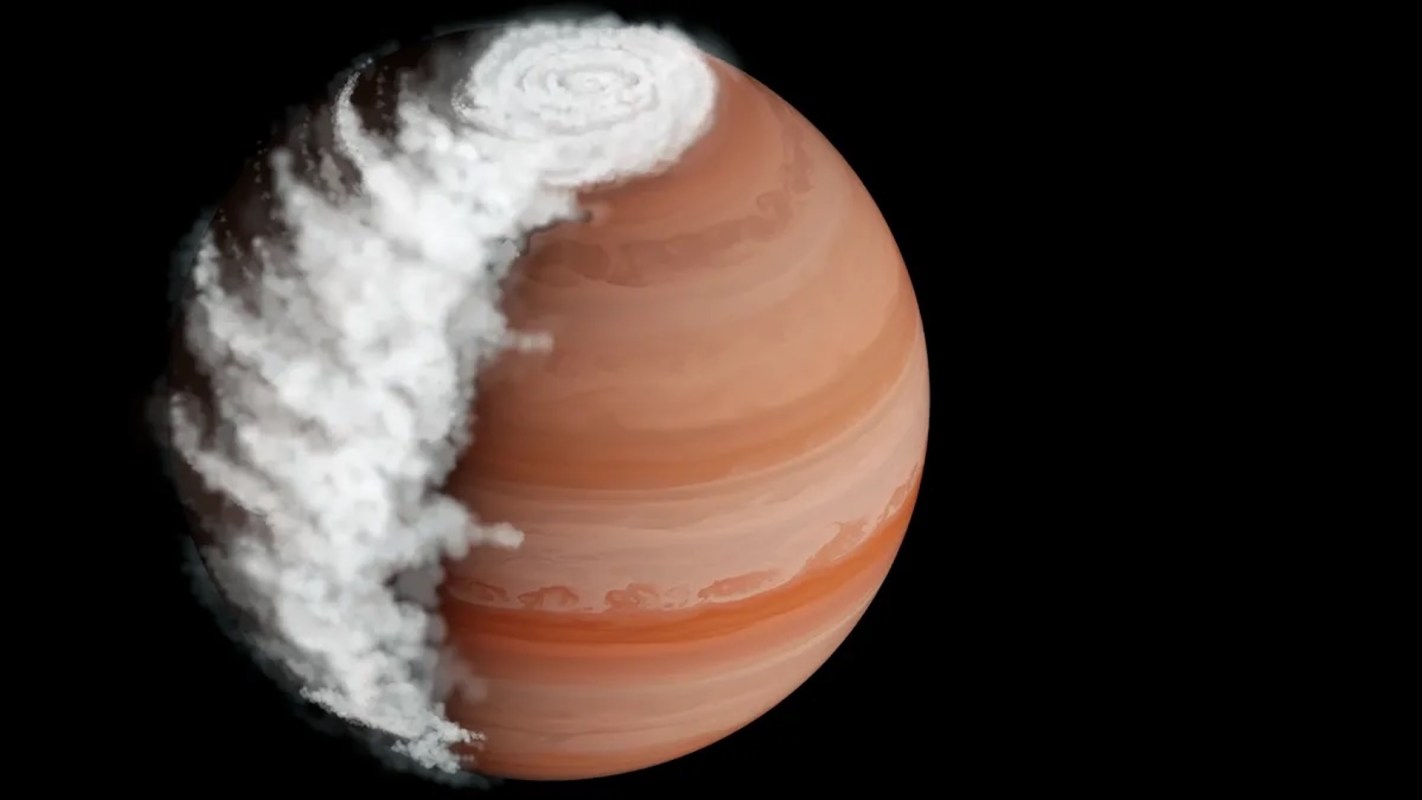
The James Webb Space Telescope has delivered one of the wildest weather reports yet from a planet beyond our solar system.
The discovery gives scientists their first direct look at a day-to-day weather cycle on a blistering "hot Jupiter" exoplanet. A giant world where sand-like clouds gather in the morning and disappear by evening.
Using the JWST, researchers studied WASP-94Ab — a gas giant about 690 light-years away and roughly 1.7 times Jupiter's size, according to a Space.com article.
The planet orbits its star every four days at a distance of just 5.1 million miles, pushing temperatures past 2,200 degrees Fahrenheit.
As the planet passed in front of its star, scientists used transit spectroscopy to analyze how starlight filtered through different parts of its atmosphere. That let them compare the planet's "morning" side with its "evening" side.
On the leading morning edge, the team detected magnesium silicate clouds. The vaporized rock can behave like airborne sand. On the evening edge, those clouds were gone, leaving a much clearer view into the atmosphere below.
TCD Picks » Quince Spotlight
💡These best-sellers from Quince deliver affordable, sustainable luxury for all




Earlier observations from Hubble could not separate those two regions. After the JWST isolated the clearer side, researchers estimated WASP-94Ab's oxygen and carbon at roughly five times Jupiter's levels.
For years, thick clouds have made hot Jupiters difficult to study because they can obscure the gases beneath them and skew chemical measurements. The JWST's clearer view suggests some earlier readings may have been distorted by weather patterns rather than by the planet's actual chemistry.
The technology could help refine the broader science of remote sensing — the same general approach used to study Earth's atmosphere, weather, and climate.
Advanced space telescopes are turning what were once little more than blurry snapshots into something closer to a forecast. Researchers are no longer just identifying what a planet is made of. They are beginning to see how it changes over the course of a day.
Scientists think there are two likely explanations for the disappearing clouds on WASP-94Ab.
One idea is that strong winds near the day-night boundary lift the material over the dark side and then sweep it into daylight, where it sinks deeper and becomes harder to detect.
The other possibility is that the clouds behave like morning fog, thinning as the day heats up.
Researchers have already widened the search. Johns Hopkins University professor David Sing and his colleagues then used the JWST on eight other hot Jupiters and found similar cloud cycles on WASP-17b and WASP-39b.
"I've been looking at exoplanets for 20 years, and general cloudiness has been a thorn in our side … we can finally pin down what the clouds are made out of and how they're condensing and evaporating as they move around the planet," Sing said in a statement.

Get TCD's free newsletters for easy tips, smart advice, and a chance to earn $5,000 toward home upgrades. To see more stories like this one, change your Google preferences here.