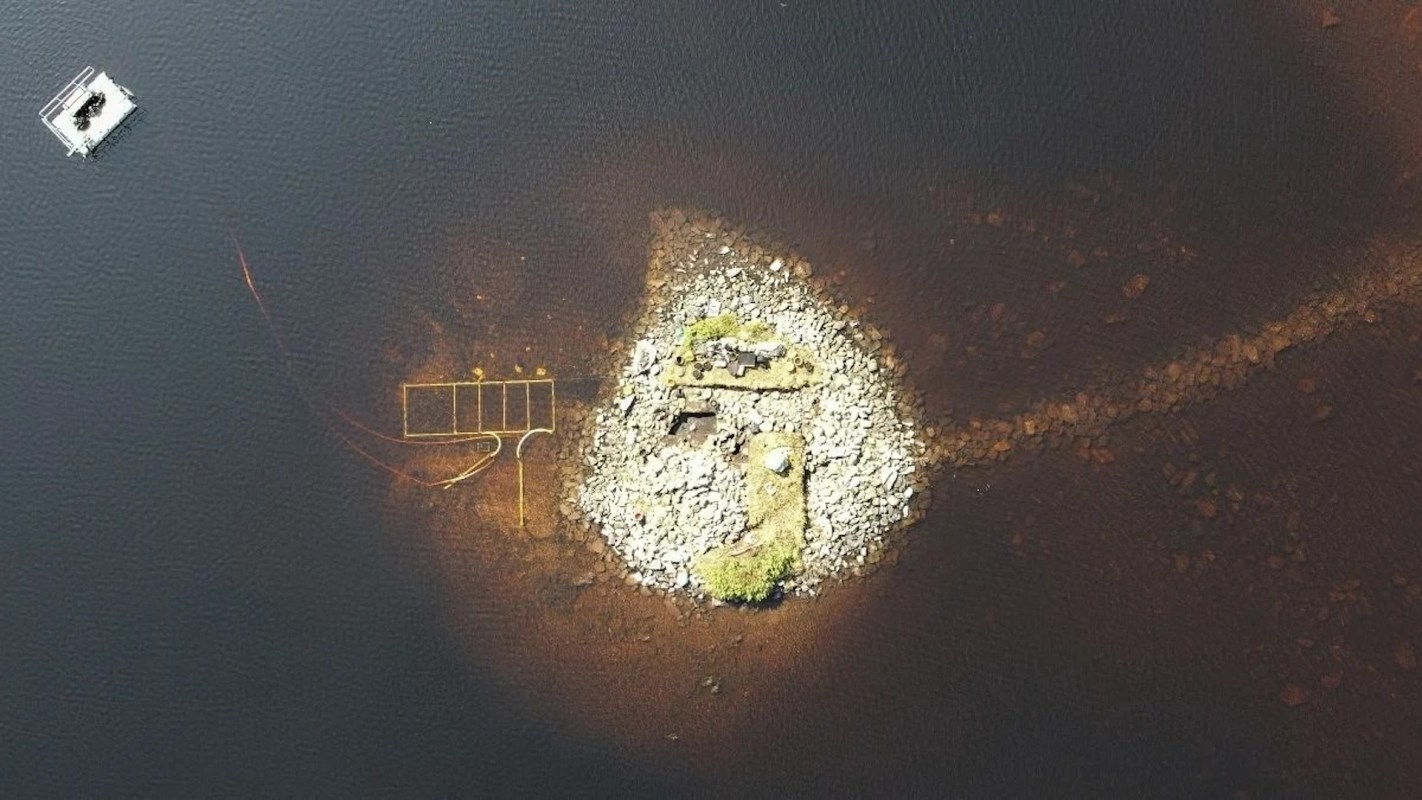
A newly analyzed artificial island in Scotland is forcing archaeologists to rethink the history of ancient engineering.
Buried beneath a stone cap in a loch on the Isle of Lewis, the site appears to be over 5,000 years old.
A study published in Advances in Archaeological Practice and cited by ScienceAlert found that the deepest foundations at Loch Bhorgastail date to the Late Neolithic period, around 3800 to 3300 B.C. Researchers reached that conclusion by combining underwater excavation, radiocarbon dating, and a new 3D imaging technique to examine what lay beneath the island's visible stone surface.
According to ScienceAlert, they uncovered a circular timber platform about 75 feet wide that was built up with brushwood and later reinforced with stone. Roughly 2,000 years later, people added more brushwood and stone, and a stone causeway was eventually built to link the island to the nearby shore.
The site is a crannog, which archaeologist Stephanie Blankshein explained as "small artificial islands that are typically thousands of years old."
"Hundreds exist in the lochs of Scotland, and many remain unexplored or undiscovered," she said, per ScienceAlert.
TCD Picks » Quince Spotlight
💡These best-sellers from Quince deliver affordable, sustainable luxury for all




Archaeologists already knew the site had a stone layer and Neolithic pottery fragments in the surrounding water. But because many important features lay in shallow, murky water, fitting the broader story together had remained difficult.
To investigate the site, researchers used stereophotogrammetry, a technique that combines photographs taken from multiple angles into a 3D model. The method is often carried out by drone above water, but Loch Bhorgastail presented a different challenge. Satellite navigation signals do not travel well underwater, and the loch's shallow, cloudy water made imaging especially difficult.
According to ScienceAlert, the team addressed that problem by having a diver follow a carefully mapped underwater route with two wide-angle, low-light cameras mounted on a frame. That approach produced clearer images of the submerged remains while also delivering strong positioning accuracy.
Those digital models were then used to guide more traditional archaeological work, including trench excavation and radiocarbon dating of wooden elements buried beneath the island's stone cap.
The discovery is a reminder that people were transforming landscapes on a large scale thousands of years before modern engineering made artificial islands seem like a recent idea.
The find also shows how much history can remain hidden even in places that seem familiar. Figuring out when and how these islands were built could help researchers better understand ancient settlement patterns, the use of local resources, and the long relationship between communities and the environments they reshaped.

Get TCD's free newsletters for easy tips, smart advice, and a chance to earn $5,000 toward home upgrades. To see more stories like this one, change your Google preferences here.