


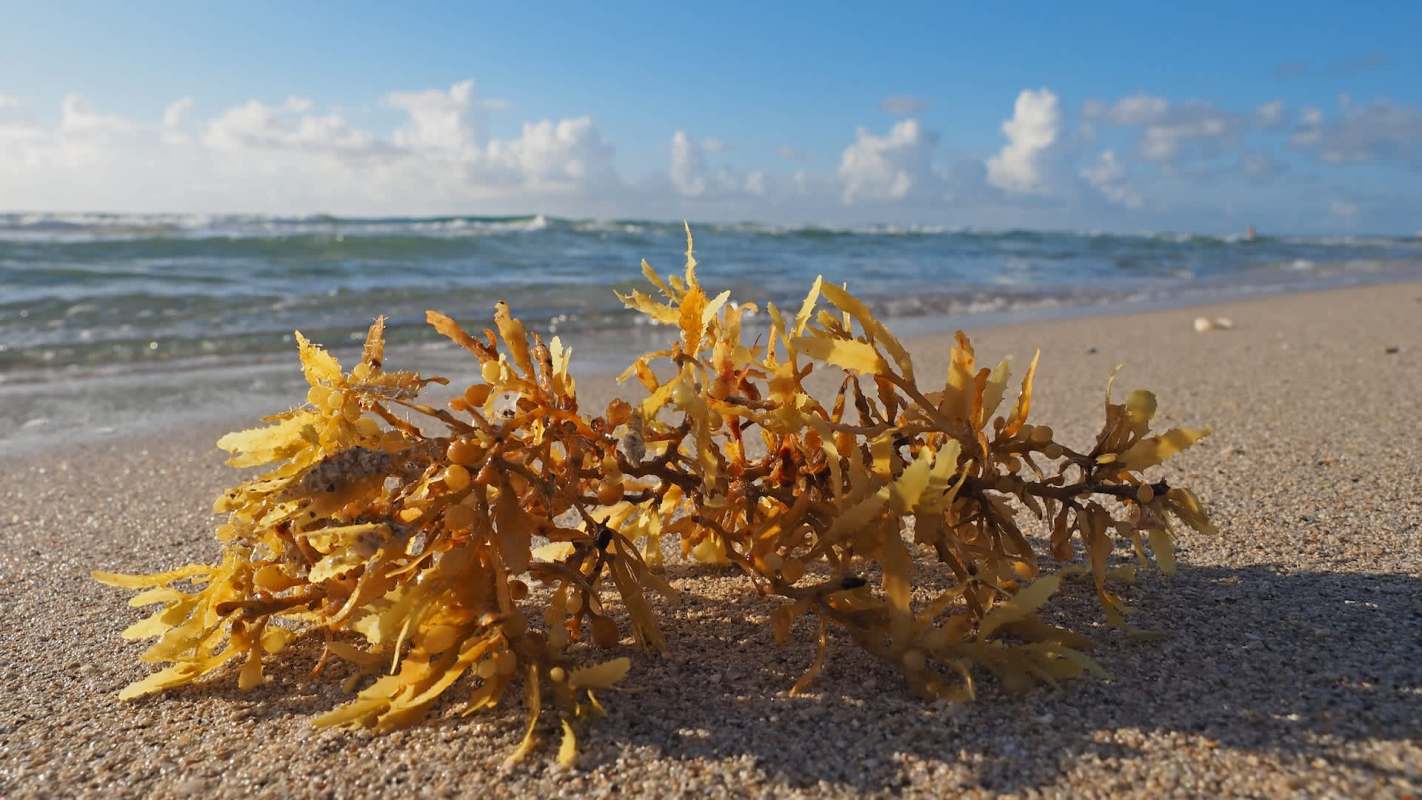
What smells like a disaster on Floridian and Caribbean beaches could one day end up in salad dressing, dessert, or dairy-free drinks.
Researchers have suggested that the same sargassum seaweed that piles up in foul-smelling mats along shorelines could be turned into a useful food ingredient rather than being treated solely as costly waste.
A study published in the journal Food Hydrocolloids examined whether pelagic sargassum — the brown seaweed that has spread across the Atlantic in massive blooms since 2011 — can be processed into alginate, a compound already widely used in foods, according to Earth.com.
That possibility could be great news because sargassum has become a major coastal headache. Massive blooms in the Great Atlantic Sargassum Belt have reached the Caribbean, Gulf of Mexico, and parts of West Africa, where they can block fishing routes, harm reefs and sea turtles, and drive tourists away when they rot on beaches.
Foodmakers use alginate to thicken sauces, stabilize ice cream, and form gels in products such as desserts and bubble tea pearls.
The challenge is safety. Raw sargassum can contain contaminants, including arsenic, cadmium, and lead. Hence, the team tested refined extraction methods designed to clean the material while preserving the properties that make alginate useful.
TCD Picks » Quince Spotlight
💡These best-sellers from Quince deliver affordable, sustainable luxury for all




For coastal communities, sargassum is more than an eyesore. Cleanup is expensive, tourism suffers, and local ecosystems are damaged when the seaweed accumulates faster than officials can remove it.
There is also a broader supply-chain benefit. If researchers can safely recover alginate from this nuisance biomass, it could create a new source of an ingredient that manufacturers already rely on in everyday foods.
Just as importantly, the study suggested that this could be done without major chemical alteration. The core chemistry of the alginate remained stable even as researchers altered its physical behavior, which could make it easier to tailor it for different food uses.
As Earth.com reported, the team first refined the extraction setup and found that heating the seaweed at 80 degrees Celsius (176 degrees Fahrenheit) for five hours yielded the highest alginate content, at about 44%.
Researchers then tested three pretreatments: autoclaving, high-pressure processing, and sonication, which uses sound waves. Each method changed the alginate differently.
More research is needed to verify safety in different seasons and locations and to see how the ingredient behaves in real food systems, as Earth.com noted. Still, the findings point to a possible path for turning a recurring coastal burden into an economic opportunity.
"If we can turn it into something useful, we shift the conversation from disposal to opportunity," said Imran Ahmad from Florida International University, according to the publication.
As Michael Cheng, Dean and professor at the FIU Chaplin School of Hospitality & Tourism Management, put it: "We are proud of Dr. Ahmad's innovative research and look forward to seeing how his work can help solve not only a Florida, but much larger global issue."

Get TCD's free newsletters for easy tips, smart advice, and a chance to earn $5,000 toward home upgrades. To see more stories like this one, change your Google preferences here.







