


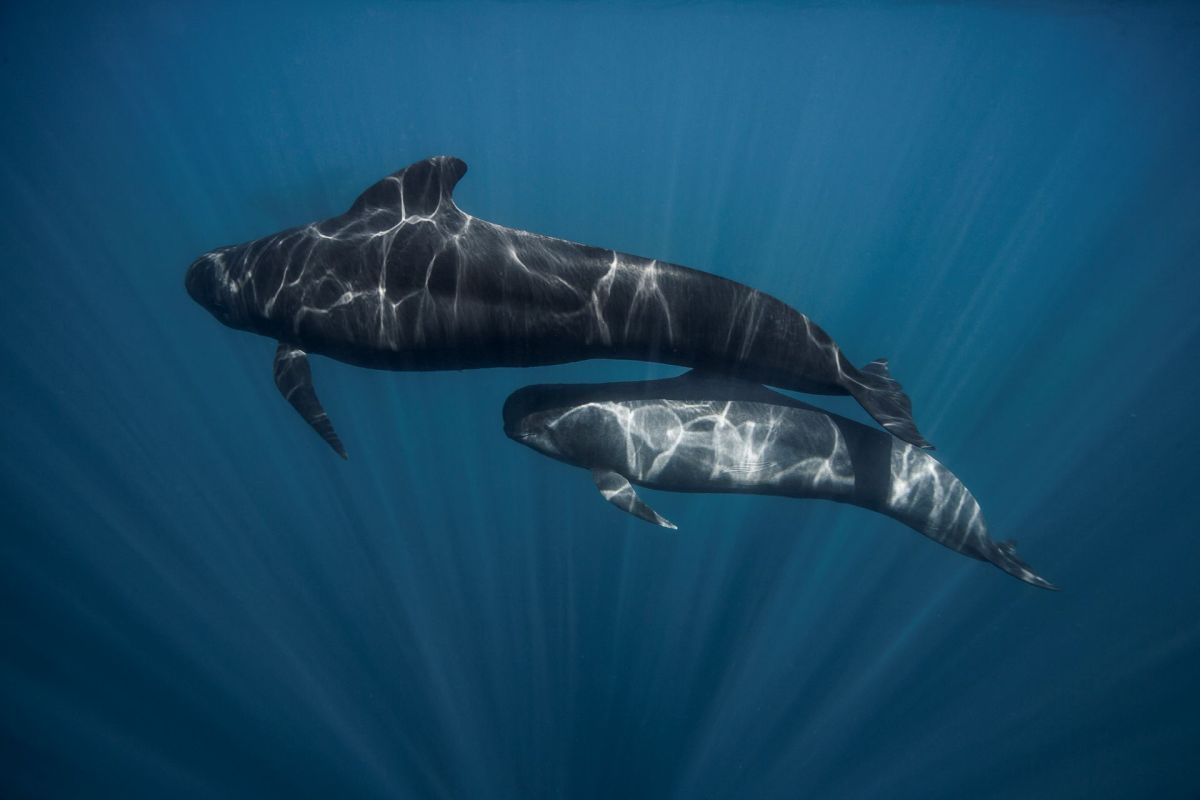
In one of the world's busiest marine corridors, endangered pilot whales are already calling at full blast — and still may not be able to hear one another over ship noise.
New research suggests the Strait of Gibraltar's relentless vessel traffic is pushing their communication to a dangerous limit.
According to a study published in the Journal of Experimental Biology, long-finned pilot whales in the Strait of Gibraltar raise the volume of some calls when background noise increases, but they can't make their reunion calls any louder.
That is especially concerning because this narrow waterway, which connects the Atlantic Ocean and Mediterranean Sea, sees more than 60,000 ships pass through each year. It is also home to a critically endangered pilot whale population of only around 250 animals.
Researchers from Aarhus University and partner institutions tagged 23 whales between 2012 and 2015 using suction-cup recording devices that tracked movement, depth, and underwater sound for roughly 24 hours at a time.
As described in the source article via Phys.org, the team analyzed 1,432 whale vocalizations and grouped them into four call types. The low-frequency and two-component calls, which can travel farther and appear to be important for finding pod members again after deep dives, were already being produced at maximum volume.
TCD Picks » Quince Spotlight
💡These best-sellers from Quince deliver affordable, sustainable luxury for all




For social animals such as pilot whales, losing contact is not a minor inconvenience.
These calls help them reunite with family groups, coordinate after foraging dives, and potentially connect with other pods during breeding. When shipping noise shrinks the distance those calls can travel, the whales' lives get harder in ways that can affect survival and recovery.
In a population this small, repeated communication breakdowns could make it more difficult to find food, raise young, and maintain healthy social bonds.
The study also highlights a broader problem: Ocean noise pollution is an often invisible consequence of global commerce. The same shipping routes that move goods for human communities can impose serious costs on marine life when vessel traffic is not managed with wildlife in mind.
That is a setback for a better future for all. Healthy oceans support coastal economies, biodiversity, and more resilient ecosystems.
Notably, the oil and gas industry spends millions of dollars lobbying against offshore wind turbine development, even leading to the United States paying wind developers billions to scrap plans to build more, with one of the key talking points being that offshore wind harms whales, which no peer-reviewed scientific paper has yet to substantiate.
Meanwhile, it seems to be that louder and moving noise from large oil tankers going across the ocean may be more significantly damaging to whales, along with the risk of oil spills from shipping and offshore drilling operations.
While the study focused on documenting the problem, its findings point toward practical solutions such as quieter ship operations, smarter routing, and speed management in sensitive habitats.
"Increasing noise essentially decreases the effective communication range, making it harder for distant animals to find each other," explains Frants Jensen, one of the authors of the study.
For a critically endangered population trying to survive in a crowded shipping lane, that warning is hard to ignore.

Get TCD's free newsletters for easy tips, smart advice, and a chance to earn $5,000 toward home upgrades. To see more stories like this one, change your Google preferences here.







