


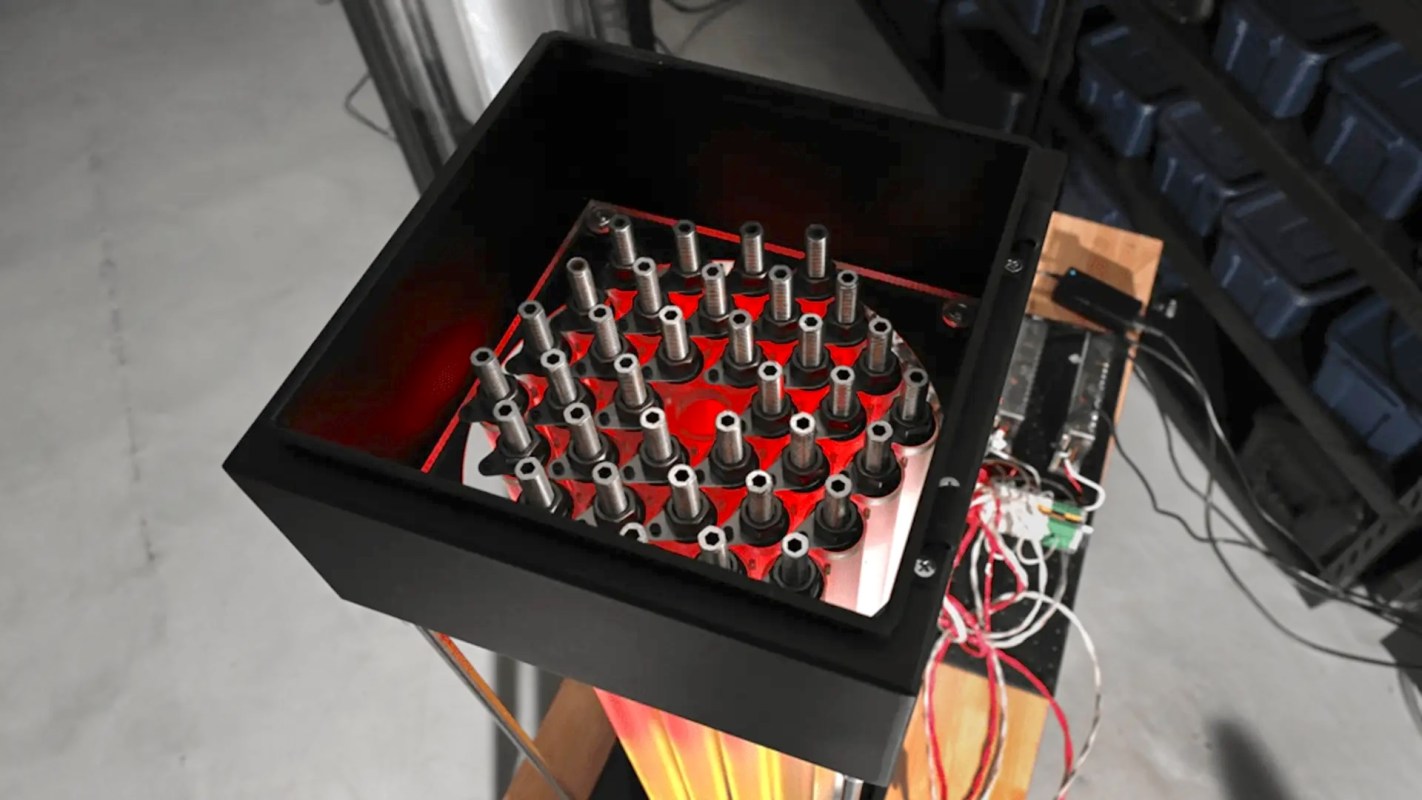
A team at Idaho National Laboratory has developed a surrogate nuclear reactor that uses LEDs to safely simulate neutron-driven reactions, accelerating research and development of real reactor cores, according to an Interesting Engineering report.
The telephone-booth-sized reactor, called ViBRANT (or Visual Benign Reactor as Analog for Nuclear Testing), is controlled by the microreactor automated control system (MACS), both of which were developed in-house.
ViBRANT serves as a bridge between computer models and the Microreactor Applications Validation and Evaluation (MARVEL) microreactor, which is an 85-kilowatt sodium-potassium-cooled system being developed at INL.
"MACS/ViBRANT is a hybrid," said Tony Crawford, an INL researcher and MARVEL's reactivity control system lead, in a press release. "The actual actuators are the same technology that will be used in the MARVEL reactor."
Nuclear fission is a process in which a nucleus is bombarded with particles such as neutrons. The nucleus then splits into two or more smaller nuclei, which generates large amounts of heat and radiation in the process. Today's nuclear reactors use this heat to boil water and drive steam turbines to produce electricity.
New reactors, including microreactors, which could play a role in powering data centers, require extensive testing to make sure they are optimized and safe for use. INL's new system helps speed up that process — reducing a day's worth of operations to just 10 minutes — without the dangers involved in testing real-world systems.
TCD Picks » Quince Spotlight
💡These best-sellers from Quince deliver affordable, sustainable luxury for all




"The fuel, the hazardous reflector and absorber materials driving reactor physics are actually replaced by benign materials amenable to light physics," Crawford continued. "It reduces all the hazards from a real reactor to safe and accessible levels with the promise of accelerating development."
Nuclear-generated electricity already supplies more than half of the carbon-free energy in the U.S., and it saves the atmosphere from more than 470 million tons of planet-warming pollution each year, according to the Nuclear Energy Institute.
These reactors operate without producing air pollution, take up a small amount of land compared to other energy-generating methods, and teams work to store the used fuel in a way that doesn't impact the environment.
While there are hazards involved, nuclear power represents a relatively low-risk option, and the new testing platform at INL will allow researchers to fine-tune future reactors in a safe manner while gaining comprehensive knowledge about the systems.
|
Which of these savings plans for rooftop solar panels would be most appealing for you?
Click your choice to see results and earn rewards to spend on home upgrades. |
 Save $1,000 this year 💸
 "By being accessible and as intuitive as watching a TV screen, nearly everyone in the reactor development process — from the modeler to the control system developer to the assembler — can get involved and learn," said Crawford.
According to the INL, the use of MACS and ViBRANT has already yielded advancements in MARVEL's hardware and software control systems and could offer insight into the next generation of advanced reactors that will play a key role in our carbon-free energy future.

Get TCD's free newsletters for easy tips to save more, waste less, and make smarter choices — and earn up to $5,000 toward clean upgrades in TCD's exclusive Rewards Club.






