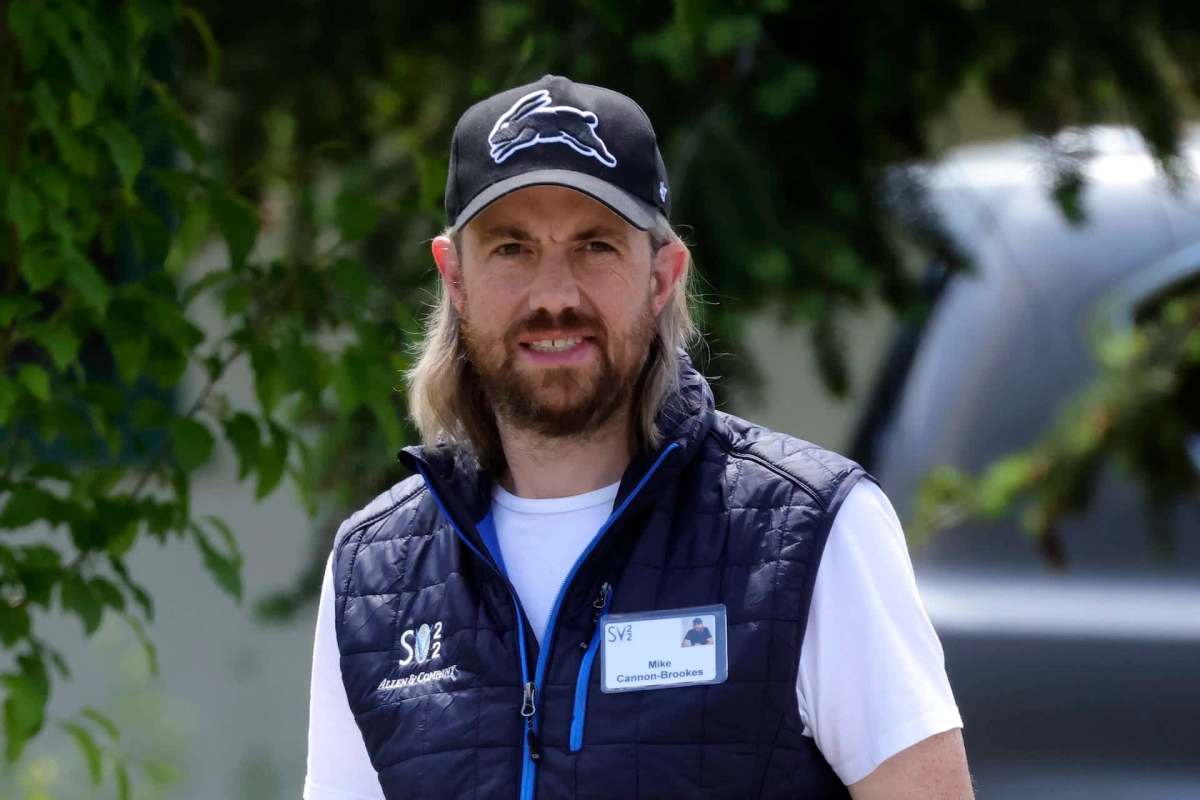
Billionaire tech executive Mike Cannon-Brookes is drawing renewed attention to the planet-warming impacts of private jets after reports revealed that he received millions of dollars from his own company to cover aviation costs, the Australian Financial Review detailed. For his part, Cannon-Brookes — who has also been described as a "climate activist" — said he takes steps to counteract the impacts of his air travel.
Official filings showed that reimbursements were paid to Cannon-Brookes, the co-founder of software firm Atlassian, for the use of his private plane. Atlassian paid Cannon-Brookes $3.7 million (about $5.7 million Australian dollars) last financial year, as the news outlet summarized. According to the reporting, the company said the arrangement for him to be paid to use his Bombardier 7500 was "reasonable, necessary, appropriate, and in the best interest" of shareholders.
The payments included $1.9 million in "travel expenses" before the jet was certified for charter use and $1.8 million in "rental expenses" for the rest of the fiscal year, reported the AFR. Atlassian said Cannon-Brookes had "not profited from this arrangement" because the rate is "below market" for similar private jets, per the reporting.
The decision by Cannon-Brookes to buy the plane has been scrutinized since the AFR reported on the purchase in March. Critics have pointed out that he has been outspoken in his support for reducing carbon pollution, but that flying in private jets runs contrary to that.
Multiple reports have remarked on the outsized contribution of private planes to pollution that traps heat in the atmosphere and overheats the planet.
A study published in Communications Earth & Environment found that emissions from private jets rose almost 50% from 2019 to 2023 as wealthy travelers used private flights more often. It found that some frequent private jet users produced almost 500 times the emissions of the average person.
TCD Picks » EDF Spotlight
💡EDF's Vital Signs newsletter delivers stories about game-changing solutions close to home and around the world

The study showed that emissions from private jets have soared in recent years. Roughly 250,000 people, collectively worth $31 trillion, emitted 17.2 million tons of carbon dioxide into the atmosphere in 2024. That's about equivalent to the pollution for the entire nation of Tanzania, according to the Associated Press.
To his credit, in March, Cannon-Brookes wrote on LinkedIn that he has a "deep internal conflict" about private air travel. He made a case that his plane is important for security and staying present with his family.
However, unlike some users of private planes, such as Taylor Swift, Cannon-Brookes would not likely claim he is recognizable enough that flying business or first class would cause a major distraction or security issue in an airport or on a plane itself. Since airports are inherently safe public places, given the security measures to enter one, it may be equally secure to travel with a pair of bodyguards if concerned about safety. Further, data suggests that flying commercial is actually 150 times less likely to result in a fatal accident.
He said he follows "an extremely rigorous carbon regime" that uses sustainable fuels and direct air capture — a technology that aims to remove carbon dioxide from the atmosphere, as the AFR summarized.
|
Should companies be required to help recycle their own products?
Click your choice to see results and speak your mind. |
 Definitely 👍
 "These options aren't practical for commercial flights — but are viable privately," added Cannon-Brookes on LinkedIn. "This means my flights actually have a net negative carbon footprint."
While efforts to mitigate are better than nothing, Cannon-Brookes did not acknowledge the possibility of running direct air capture without flying private, however, especially since all the monetary savings from flying commercial could be reinvested in meaningful pollution reduction.
In an opinion piece, AFR writer Jessy Wu pushed back with skepticism about "experimental" technology addressing the plane's pollution. "The most effective carbon-reduction strategy is simply not to fly private in the first place," Wu wrote.

💰Get TCD's free newsletters for easy tips to save more, waste less, and make smarter choices — and earn up to $5,000 toward clean upgrades in TCD's exclusive Rewards Club.