


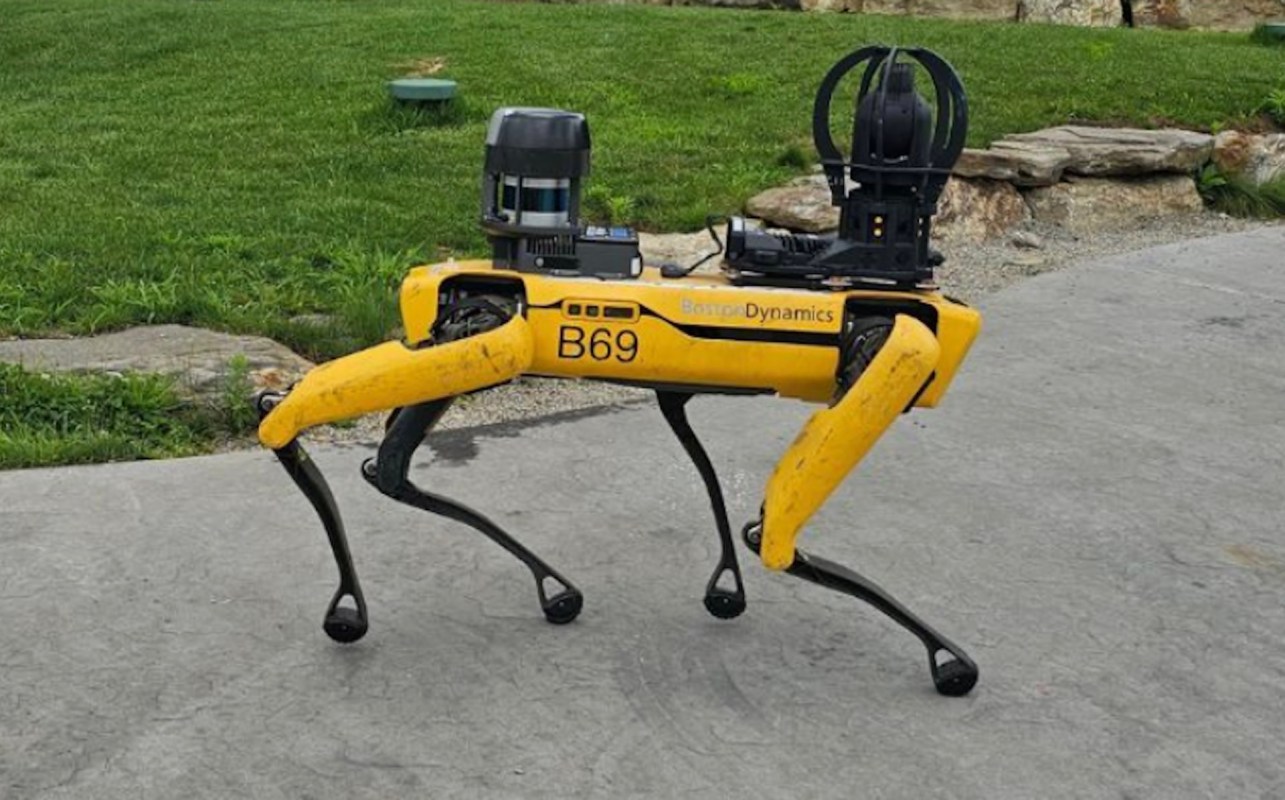
A team from Texas A&M University has a new use for a Boston Dynamics Spot robot: herbicide-free weed control for agricultural fields.
Interesting Engineering reports that the team started with a Spot Mini quadruped robot with a Unitree Z1 manipulator arm. This is a mechanical arm that can lift just over three pounds and is powered by the robot's own internal battery.
The Texas A&M team then programmed the robot with a weed detection algorithm and armed it with a propane torch.
That might conjure alarming images of a field in flames, but in fact, the robot doesn't set the weeds on fire. Instead, it uses the heat radiating from the flame to heat the core of each weed, stunting its growth for weeks, Interesting Engineering explains.
Moreover, "experiments showed that the system works," according to the publication.
Much of the team's programming work went into having the robot predict reprojected images, a task which it can do with over 76% accuracy using two thermal cameras. With a third camera, it can identify weeds with 94.4% precision.
TCD Picks » Quince Spotlight
💡These best-sellers from Quince deliver affordable, sustainable luxury for all




The researchers tested their Spot unit in two settings: a raised garden bed and a cotton field, per the news report. The robot plotted a course to each weed and heat-treated them no matter what position it started from. The weeds in question were common species, including sunflower, ragweed, and smellmelon.
Robotic weed control is a fascinating alternative to traditional methods. While home gardeners may weed by hand, that's much too labor-intensive for a large-scale farm, and spraying herbicides is the only viable option. But herbicides and other chemical treatments are often toxic to humans and the environment. An automated, chemical-free alternative could lead to healthier people, as well as protect the delicate balance of the natural world.
Another innovative team just developed a way to use AI to reduce farmers' pesticide use by up to 50%. More tech on the average farm could mean less chemical exposure for all.
As for the Texas A&M team, which published its work in the journal arXiv, Interesting Engineering reports that its next goals are to get its robot to treat multiple weeds at once and to use additional treatment methods like electrocution to safely take care of them.

Join our free newsletter for weekly updates on the latest innovations improving our lives and shaping our future, and don't miss this cool list of easy ways to help yourself while helping the planet.






